FEATURESCompact design, Easy mounting, Low maintenance, Less space consumption, Suitable for wet, dusty and corrosion aggressive environments Cost effective .
APPLICATION AREASteel Industries, Cable Industries, Paper Industries, Wire Drawing Machine, Tyre Industries, Textile Machineries, Text Rigs .
Hydraulic Rail Clamps
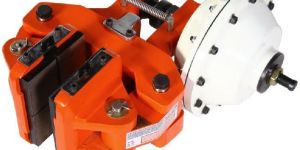
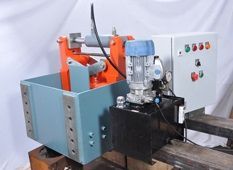
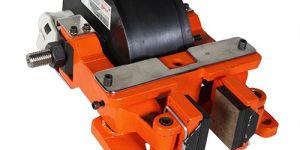
The subject rail clamp is used as a parking brake for the trucks operating at sea shores. Refer to figure 1.1
for general arrangement of the clamp. It consists of two main links whose one end is connected to
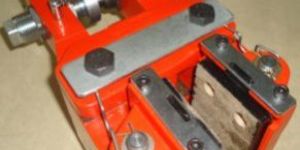
hydraulic actuator while the other end is fitted with brake pads. Both main links are hinged and supported
by internal frame. The main links are also connected to springs through connecting links. The external
frame is connected to truck. During the parking condition, the truck is held by clamping of the rails by
spring force. To move the truck, rail clamp is release by actuating hydraulic cylinder. The external and internal frames are connected through a floating arrangement to accommodate the misalignment generated during truck movement. During parking condition, the clamp is subjected to a separating force generated due to wind or storm acting on the truck. The objective of the present work was to design a rail clamp of 130 KN capacity.
Hydraulic Rail Clamps
The subject rail clamp is used as a parking brake for the trucks operating at sea shores. Refer to figure 1.1
for general arrangement of the clamp. It consists of two main links whose one end is connected to
hydraulic actuator while the other end is fitted with brake pads. Both main links are hinged and supported
by internal frame. The main links are also connected to springs through connecting links. The external
frame is connected to truck. During the parking condition, the truck is held by clamping of the rails by
spring force. To move the truck, rail clamp is release by actuating hydraulic cylinder. The external and internal frames are connected through a floating arrangement to accommodate the misalignment generated during truck movement. During parking condition, the clamp is subjected to a separating force generated due to wind or storm acting on the truck. The objective of the present work was to design a rail clamp of 130 KN capacity.
Friction Materials-Sintered
Metal-ceramic bronze-graphite friction material with high content of ceramic components and graphite, designed for a dry friction use.
Material characteristics :
High co-efficient of friction
High wear resistance
The lining is solidly joint to its steel base pad by the layer of connecting material
Good thermal stability up to 450°C, for a short term up to 800°C
Small effect on the opposite surface
Suitable for grinding, drilling and recess work
Friction co-efficient stability in a wide range of operating conditions
Typical area of use :
Suitable as a dry friction material for medium and heavy workloads, e.g. disc brakes for the aircraft or for a heavy earth machinery.
Recommended operating conditions :
Specific pressure : p < 3.5 MPa Sliding speed : v < 40 m.g-1 Temperature sustained : 450°C Short term temperature : 800°C Friction surface : steel, cast iron, cast steel
Friction data :
Dynamic coeff. of friction fdyn : 0.350 – 0.550 Static coeff of friction fstat : 0.450 – 0.530
Physical – Mechanical characteristics :
Density : γ = 4.6 g/cm3 Specific heat : c = 5.1kJ/kg.K Coeff. of thermal conductivity : λ = 4.0 W/m.K Co-eff of thermal expansion : α* = 17.6 x 10⁻⁶/K Modulus of elasticity : Ep = 393 MPa (under compress.) Tensile strength : δdt = 26MPa Shearing strength : δds = 53MPa
*α(20-500°C)
Friction characteristics :
The course of the friction coefficient, specific abrasive wear and temperature were measured on the laboratory testing bench under the following conditions.
Specific pressure : p = 0.5 – 3.0 MPa Sliding speed : v = 10 – 30 m.s-1 Friction surface : special cast iron CNMCH
Friction Materials-Sintered
Metal-ceramic bronze-graphite friction material with high content of ceramic components and graphite, designed for a dry friction use.
Material characteristics :
High co-efficient of friction
High wear resistance
The lining is solidly joint to its steel base pad by the layer of connecting material
Good thermal stability up to 450°C, for a short term up to 800°C
Small effect on the opposite surface
Suitable for grinding, drilling and recess work
Friction co-efficient stability in a wide range of operating conditions
Typical area of use :
Suitable as a dry friction material for medium and heavy workloads, e.g. disc brakes for the aircraft or for a heavy earth machinery.
Recommended operating conditions :
Specific pressure : p < 3.5 MPa Sliding speed : v < 40 m.g-1 Temperature sustained : 450°C Short term temperature : 800°C Friction surface : steel, cast iron, cast steel
Friction data :
Dynamic coeff. of friction fdyn : 0.350 – 0.550 Static coeff of friction fstat : 0.450 – 0.530
Physical – Mechanical characteristics :
Density : γ = 4.6 g/cm3 Specific heat : c = 5.1kJ/kg.K Coeff. of thermal conductivity : λ = 4.0 W/m.K Co-eff of thermal expansion : α* = 17.6 x 10⁻⁶/K Modulus of elasticity : Ep = 393 MPa (under compress.) Tensile strength : δdt = 26MPa Shearing strength : δds = 53MPa
*α(20-500°C)
Friction characteristics :
The course of the friction coefficient, specific abrasive wear and temperature were measured on the laboratory testing bench under the following conditions.
Specific pressure : p = 0.5 – 3.0 MPa Sliding speed : v = 10 – 30 m.s-1 Friction surface : special cast iron CNMCH
Friction Materials-Organic
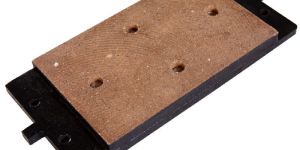
Kateel Friction Material-Organic is one of the Kateel ranges of non-asbestos friction material. It is a compressive molded product, Black / Greenish in color, and having a mixture of fillers of Copper, Iron and non-metallic substances. The material is produced in only flat sheet form and suitable for use in dry condition
Physical properties :
Specific gravity : 2.00 g/cm3 Rockwell hardness : L74 Ultimate compressive strength : 860 Kg/cm Ultimate shear strength : 118 Kg/cm Tensile strength : 140 Kg/cm Thermal conductivity : 6.0 W/mºC
Recommended operating range :
Max temperature : 350ºC Max continuous temp : 150ºC Max rubbing speed : 24 m/sec
Size Range :
Thickness : 3-50mm Length : 350mm Width : 350mm
Recommended mating surface :
Good quality close grained pearlitic cast iron Cold rolled steel with BHN 200 or more.
Machining :
Use of carbide tipped tools is recommended for Drilling, Turning and boring of this material.
Friction Materials-Organic
Kateel Friction Material-Organic is one of the Kateel ranges of non-asbestos friction material. It is a compressive molded product, Black / Greenish in color, and having a mixture of fillers of Copper, Iron and non-metallic substances. The material is produced in only flat sheet form and suitable for use in dry condition
Physical properties :
Specific gravity : 2.00 g/cm3 Rockwell hardness : L74 Ultimate compressive strength : 860 Kg/cm Ultimate shear strength : 118 Kg/cm Tensile strength : 140 Kg/cm Thermal conductivity : 6.0 W/mºC
Recommended operating range :
Max temperature : 350ºC Max continuous temp : 150ºC Max rubbing speed : 24 m/sec
Size Range :
Thickness : 3-50mm Length : 350mm Width : 350mm
Recommended mating surface :
Good quality close grained pearlitic cast iron Cold rolled steel with BHN 200 or more.
Machining :
Use of carbide tipped tools is recommended for Drilling, Turning and boring of this material.
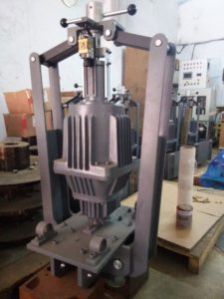
The subject rail clamp is used as a parking brake for the Tripper car operating at sea shores. It consists of two main links and is connected to Electro Hydraulic actuator while the other end is fitted with Brake pads. Both main links are hinged and supported by internal frame. The main links are also connected to springs through connecting links. The external frame is connected to tripper structure. During the parking condition, the tripper car is held by clamping of the rails by spring force. To move the tripper car, rail clamp is release by actuating electro hydraulic thruster. The external and internal
frames are connected through a floating arrangement to accommodate the misalignment generated during tripper car movement. During parking condition, the clamp is subjected to a separating force generated due to wind
or storm acting on the tripper car. The objective of the present work was to design a rail clamp of 2T capacity.
TECHNCIAL DATA
Pad dimension: 60 mm x 30 mm
No. of pads: 3 per side
Pad area: 60 x 30 x 3 = 5400 mm2 per side
Max. Allowable wear of brake pad : 5 mm
Nominal co-efficient of friction: 0.25
Clamping force up to:20000 N Max.
Operating by Thruster, capacity 301/6.
Weight of brake: 400 Kgs
The subject rail clamp is used as a parking brake for the Tripper car operating at sea shores. It consists of two main links and is connected to Electro Hydraulic actuator while the other end is fitted with Brake pads. Both main links are hinged and supported by internal frame. The main links are also connected to springs through connecting links. The external frame is connected to tripper structure. During the parking condition, the tripper car is held by clamping of the rails by spring force. To move the tripper car, rail clamp is release by actuating electro hydraulic thruster. The external and internal
frames are connected through a floating arrangement to accommodate the misalignment generated during tripper car movement. During parking condition, the clamp is subjected to a separating force generated due to wind
or storm acting on the tripper car. The objective of the present work was to design a rail clamp of 2T capacity.
TECHNCIAL DATA
Pad dimension: 60 mm x 30 mm
No. of pads: 3 per side
Pad area: 60 x 30 x 3 = 5400 mm2 per side
Max. Allowable wear of brake pad : 5 mm
Nominal co-efficient of friction: 0.25
Clamping force up to:20000 N Max.
Operating by Thruster, capacity 301/6.
Weight of brake: 400 Kgs
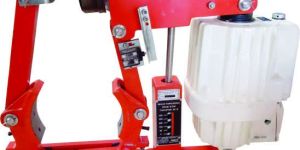
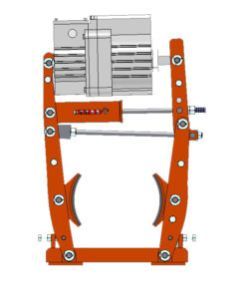
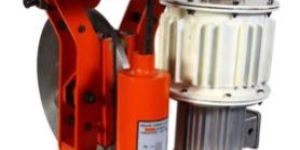
The brake assembly contains of a brake arm, brake shoe, base frame, actuating lever, brake spring and an electro hydraulic thruster. The brake shoe is mounted on the brake arm and the gap between the brake drum and brake pad is adjusted by spring mechanism. A heavy spring suitable to give required braking force, is mounted in a square tube and a graduation scale is provided outside to note the spring force .The spring force can be adjusted suitably by tightening the nut at the bottom of the spring, All the components are mounted on the base frame
This brake is normally in closed condition due to the spring force. The hydraulic thruster is actuated by an electric motor. When the power supply is on, the thruster motor is switched on and hydraulic pressure is developed in the hydraulic thruster. The piston is actuated instantaneously and the brake is released. When the power is cut off, the thruster motor stops thus releasing the hydraulic pressure. The thruster piston is pushed back and the brake pads clamp on to the brake drum. Due to the spring force, brake is applied.
Application Area
Cranes
Conveyors
Material Handling Equipment.
...more
Electro Hydraulic Horizontal Direction Drum Brakes
The brake assembly contains of a brake arm, brake shoe, base frame, actuating lever, brake spring and an electro hydraulic thruster. The brake shoe is mounted on the brake arm and the gap between the brake drum and brake pad is adjusted by spring mechanism. A heavy spring suitable to give required braking force, is mounted in a square tube and a graduation scale is provided outside to note the spring force .The spring force can be adjusted suitably by tightening the nut at the bottom of the spring, All the components are mounted on the base frame
This brake is normally in closed condition due to the spring force. The hydraulic thruster is actuated by an electric motor. When the power supply is on, the thruster motor is switched on and hydraulic pressure is developed in the hydraulic thruster. The piston is actuated instantaneously and the brake is released. When the power is cut off, the thruster motor stops thus releasing the hydraulic pressure. The thruster piston is pushed back and the brake pads clamp on to the brake drum. Due to the spring force, brake is applied.
Application Area
Cranes
Conveyors
Material Handling Equipment.
Clutch Buttons
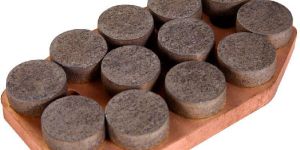
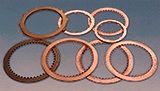
Kateel Engineering Industry Pvt. Ltd., is a 25 years old company engaged in manufacturing Industrial Disc Brakes, Drum Brakes, Industrial Valves and Friction Liners and for the last couple of years, entered into manufacturing 4 wheeler brake pads and Sintered Clutch Buttons for the Heavy Vehicles, these pads have Resistant to high temperature, long service life and suitable for engineering clutch.
The Sintered Clutch Buttons are manufactured within the state of art technology and meets all the standards required for the application.
Clutch Buttons
Kateel Engineering Industry Pvt. Ltd., is a 25 years old company engaged in manufacturing Industrial Disc Brakes, Drum Brakes, Industrial Valves and Friction Liners and for the last couple of years, entered into manufacturing 4 wheeler brake pads and Sintered Clutch Buttons for the Heavy Vehicles, these pads have Resistant to high temperature, long service life and suitable for engineering clutch.
The Sintered Clutch Buttons are manufactured within the state of art technology and meets all the standards required for the application.
Secondary Business TypeManufacturer / Exporters / Wholesale Suppliers
Year of Establishment1984
No. of Employees51 - 100
Annual TurnoverRs. 5 to 25 Crore Approx.
Opening Hours
SUN : Closed
MON : 9:30 AM - 6:30 PM
TUE : 9:30 AM - 6:30 PM
WED : 9:30 AM - 6:30 PM
THU : 9:30 AM - 6:30 PM
FRI : 9:30 AM - 6:30 PM
SAT : 9:30 AM - 6:30 PM
Kateel Engineering Industry from Bangalore, Karnataka Established in 1984 is Retailer of Brake Liners, Brake Pads, industrial brakes, Valves, PNUEMATIC ACTIVE Disc Brakes, Pnuematic FAILSAFE Disc Brakes, hydraulic Active Disc Brakes, Hydraulic failsafe Disc Brakes, Lever operated disc brakes, Electro Magnetic Disc Brakes.


 Reviews & Ratings
 Write a Review


 Post Free Ad