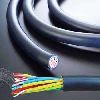
RUBBER TRAILING CABLE
Get Price Quote
Rubber insulation in Rubber Trailing Cables holds its vital role in specific application where high flexibility and comparatively high temperature is required. Rubber insulation also permits simple splices and terminations. Sythetic rubber such as butyle rubber, Etnylene Propylene rubber, Poly Chloroprene rubber, Chlorosulphunated polyethylene rubber have better heat resistance, oil resistance and resistance against influence as compared to natural rubber. Out of all the synthetic rubber, silicon rubber has excellent die-electric characteristics. It is possible to operate silicon rubber insulated cables at ambient temperature of upto 180oC continuously. The polychloroprene rubber, chlorosulphonatated, nitrille sheating are formulated against high abrasion, oil, weather and fire resistance properties. EPR insulation with CSP sheathing can withstand high ambient condition having long durable ageing properties.
Technical Specification :
Construction : Single cable comprising multiple elements like power cores, control cores, signaling pairs, etc for multipurpose functions.
Voltage Grade : 600/1100 V-AC
Conductor : Class-5 flexible tinned or bare copper
Insulation : EPR
Screening (if applicable) : Tinned or bare copper wire braid
Inner Sheath : HOFR- Elastomer
Anti Kink Braid : Fabric braid embedded between inner and outer sheath
Outer Sheath : HOFR Elastomer
Features : Designed to withstand continuous reeling and unreeling Sheath materials that have a high degree of flex fatigue resistance Excellent heat, oil and fire resistant properties
Operating Temperature : -20 Deg C to +90 Deg C
Test Voltage : 2500 V-AC
Bending Radius : 10D
Core Marking : 1-5 cores colour coded as Green/Yellow, Blue, Brown, Black, Grey or Coloured Rubberised cotton tapes. 6 cores and above with numbered cores, with one earth core of Green/Yellow.
Standards : IEC-60228, IEC-60502, IEC-60332
...more
 Back
Back


 Post Free Ad