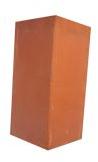
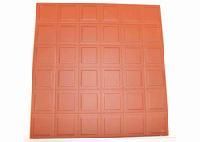
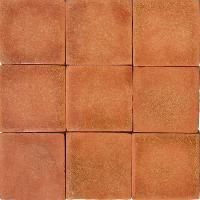
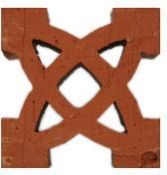
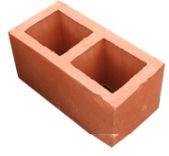
decorative Terracotta Tiles, Weathering Tiles, Decorative tiles, Manglore Tiles, Slpit Tiles, Wire Cut Bricks, Roofing Tiles, Floor Tiles, Jallys etc...
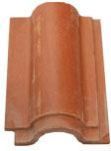
The reason, clay or terracotta roof tiles enjoy such popularity is because of the product itself. Clay roof tiles have been around for centuries and have proven their durability.
Weathering tiles are used in all modern age buildings because of its incomparable capacity to defend the heat. And being natural , right from the production to the usage it is eco friend
decorative Terracotta Tiles, Weathering Tiles, Decorative tiles, Manglore Tiles, Slpit Tiles, Wire Cut Bricks, Roofing Tiles, Floor Tiles, Jallys etc...
The reason, clay or terracotta roof tiles enjoy such popularity is because of the product itself. Clay roof tiles have been around for centuries and have proven their durability.
Weathering tiles are used in all modern age buildings because of its incomparable capacity to defend the heat. And being natural , right from the production to the usage it is eco friend
Secondary Business TypeManufacturer / Exporters / Wholesale Suppliers
Opening Hours
SUN : Closed
MON : 9:30 AM - 6:30 PM
TUE : 9:30 AM - 6:30 PM
WED : 9:30 AM - 6:30 PM
THU : 9:30 AM - 6:30 PM
FRI : 9:30 AM - 6:30 PM
SAT : 9:30 AM - 6:30 PM
The oldest shaped bricks found date back to 7,500 B.C.They have been found in Çayönü, in the upper Tigris region, and in south east Anatolia close to Diyarbakir. Other more recent findings, dated between 7,000 and 6,395 B.C., come from Jericho and Catal Hüyük. From archaeological evidence, the invention of the fired brick (as opposed to the considerably earlier sun-dried mud brick) is believed to have arisen in about the third millennium BC in West India. The bible, in the book of Exodus, tells how Pharaoh forced the Israelites to make bricks without providing any straw for their manufacture and how his oppression led to their leaving Egypt for the promised land. These ancient bricks were former of mud and straw and were dried by the heat of the sun. They were not very stable or durable. From about 3500 BC the technique of firing bricks in a kiln was discovered In the medieval period, the revival of the craft took place first along the eastern seaboard, where contacts with the continent were strongest and provided a strong fire proof alternative to thatching. In 1212 AD, King John issued building by-laws for London to eliminate combustible roof coverings and replace them with tiles. Since that time, clay has been a highly sought-after material. By the 18th century, tiles had become the standard roof covering wherever there was an abundant local supply of suitable raw materials, a source of fuel and a thriving craft tradition. The production of clay tiles began as a very small scale industry, with many districts having only one source of supply. Over time, roofers developed their own construction detailing and distinctive methods of laying roofs that provided their neighborhoods with distinctive local appearance and indigenous form old building.








![Mangalore Tiles [ ATC-D-161]](http://iyp.wlimg.com/product_images/bc-small/dir_98/2937974/mangalore-tiles-atc-d-161-1527136016-3896267.jpeg)




 Reviews & Ratings
 Write a Review


 Post Free Ad