Coir Fiber
Get Price Quote
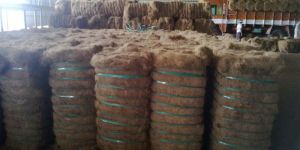
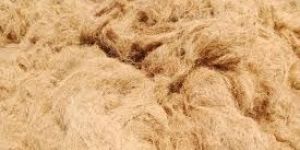
Coir Fiber which we offer is a versatile natural fiber extracted from Mesocarp Tissue, or husk of the coconut fruit. The Coir Fiber, offered by us, is of golden color when cleaned after removing from coconut husk; and hence it is also known as “The Golden Fiber". Our Coir Fiber is the fibrous husk of the coconut shell. Various characteristics make the Coir Fiber quite useful in manufacturing floor and outdoor mats, aquarium filters, cordage and rope, and garden mulch.
Features Of Coir Fiber
Moth-proof; resistant to fungi and rotProvides excellent insulation against temperature and soundNot easily combustibleFlame-retardantUnaffected by moisture and dampnessTough and durableResilient; springs back to shape even after constant useTotally static freeEasy to clean
Structure Of Coir fiber
The individual fiber cells are narrow and hollow, with thick walls made of cellulose.They are pale when immature but later become hardened and yellowed as a layer of lignin, is deposited on their walls. Mature brown coir fibers contain more lignin and less cellulose than fibers such as flax and cotton and so are stronger but less flexible.They are made up of small threads, each less than 0.05 inch (1.3 mm) long and 10 to 20 micrometers in diameter.White fiber is smoother and finer, but also weaker.The coir fiber is relatively waterproof and is the only natural fiber resistant to damage by salt water.
Varieties Of Coconut Coir Fiber
Brown Fiber
The fibrous husks are soaked in pits or in nets in a slow moving body of water to swell and soften the fibers.The long bristle fibers are separated from the shorter mattress fibers underneath the skin of the nut, a process known as wet-milling.The mattress fibers are sifted to remove dirt and other rubbish, dried and packed into bales.Some mattress fiber is allowed to retain more moisture so that it retains its elasticity for 'twisted' fiber production.The coir fiber is elastic enough to twist without breaking and it holds a curl as though permanently waved.Twisting is done by simply making a rope of the hank of fiber and twisting it using a machine or by hand.The longer bristle fiber is washed in clean water and then dried before being tied into bundles or hunks.It may then be cleaned and 'hackled' by steel combs to straighten the fiber sand remove any shorter fiber pieces.Coir bristle fiber can also be bleached and dyed to obtain hanks of different colours.White Fiber
The immature husks are suspended in a river or water-filled pit for up to ten months.During this time micro-organisms break down the plant tissues surrounding the fibers to loosen them - a process known as retting.Segments of the husk are then beaten by hand to separate out the long fibers, which are subsequently dried and cleaned.Cleaned fiber is ready for spinning into yarn using a simple one-handed system or a spinning wheel.
Uses / Applications
Brown coir is used in brushes, doormats, mattresses and sacking.A small amount is also made into twine.Pads of curled brown coir fiber, made by needle-felting (a machine technique that mats the fibers together) are shaped and cut to fill mattresses and for use in erosion control on river banks and hillsides.A major proportion of brown coir pads are sprayed with rubber latex which bonds the fibers together (rubberized coir) to be used as upholstery padding for the automobile industry in Europe.The material is also used for insulation and packaging.The major use of white coir is in rope manufacture.Mats of woven coir fiber are made from the finer grades of bristle and white fiber using hand or mechanical looms.Coir is recommended as substitute for milled peat moss because it is free of bacteria and fungal spores.
Some Coir Facts
Coir is a versatile natural fiber extracted from mesocarp tissue, or husk of the coconut fruit.The husk contains 20% to 30% fiber of varying length.After grinding the husk, the long fibers are removed and used for various industrial purposes, such as rope and mat making.The remaining material, composed of short and medium-length fibers as well as pith tissue, is commonly referred to as waste-grade coir.The waste grade coir may be screened to remove part or all of the fibre, and the remaining product is referred to as coir pith.
Physical Properties
Ultimate length0.6 mm Diameter/width 16 micron Single fibre Length 6 to 8 inches Density1.4 g/cc Tenacity10 g/ tex Breaking Elongation 30% Moisture regain at 65% RH 10.5% Swelling in water 5% in diameter
...more










 Post Free Ad