Demineralizer System
Get Latest Price
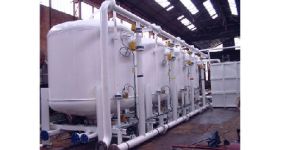
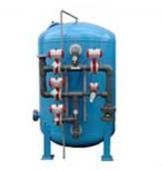
The Demineralizer System is an important part of water treatment plant. The Water Demineralizer System is manufactured in the latest sophisticated technology ensuring high level of performance. The Integral Water Demineralizer System has gained huge demand in the industry for its efficiency level. Besides a manufacturer, we are among the internationally acclaimed Exporters of Demineralizer System.
There are two basic kinds of demineralizer systems, separate-bed and mixed-bed. In a separate-bed system, cation resins and anion resins and anion resins are loaded into separate pressure vessels. During the service cycle, water passes through the cation bed first, where undesirable positive ions (cations) such as sodium (Na+), calcium (Ca+2), and magnesium (Mg+2) are exchanged for hydrogen (H+) ions. The water next passes through the anion bed, where a similar process removes undesirable negative ions (anions) such as chloride (Cl-), sulfate (SO4-2), and bicarbonate (HCO3-), replacing them with hydroxyl (OH-). Pure water is produced from the combination of hydrogen and hydroxyl ions. In a mixed-bed system, also referred to as a polisher, the cation and anion resins are loaded into the same vessel.
Where they are in contact with each other. This allows the hydrogen and hydroxyl ions to combine instantaneously to produce water of the highest possible purity. In any demineralizer, the capacity of the resins to exchange ions is finite. As the capacity becomes stressed, ion leakage occurs in the effluent. This is called the breakthrough point. When the breakthrough point is detected, the bed is switched from a service cycle to a regeneration cycle. During the regeneration cycle, the beds are backwashed to flush out particulate matter, then chemically regenerated with acid and caustic. Finally, the beds are rinsed thoroughly to yield a service cycle ready condition.
The breakthrough point of a demineralization bed is impacted by its ion exchange capacity, which is affected by water flow rate, ion contaminant concentration, and feed water composition. Regeneration of a bed is costly, due to the need for chemicals and rinse water, pretreatment, regeneration waste treatment, and labor. Thus the goal is to maintain the service cycle of the bed as long as possible, while ensuring that the system continues to deliver water of the required purity.
Conductivity sensors are successfully employed on demineralizers to monitor the operation of the bed and to predict and signal the all-important breakthrough Point.
In a cation bed, salt impurities are converted to an acid form, typically hydrochloric acid (HCl). When this happens, the conductivity of the water increases dramatically, because the hydrogen ion is far more conductive than the mineral ion it has replaced.
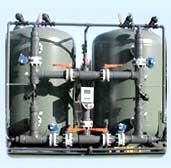
CLEARION water demineralisers come in various capacities. The smaller capacity demineralisers are of portable type and there are 4 such models.
The smallest, models are bench models and are essentlly cabinest made of FRP in which is housed to FRP Cylinder for cation & anion, Access to the inside of the cabinet is form behind where a sliding door is provided. Conductivity cell, metter & circuit box, a multiply valve manifold, are fitted inside the cabinet. The demineraliser is oprated by controlling then knobs of the value manifold. The conductivity metter indicates the condition of the plant, i.e. Whether the plant is producting demineralised water or it requires regeneration. A PVC regeneration tank is also provided.
Larger unites are of Mild Steel Rubber lined construction. They are provided with distribution & collection systems. For diameters up to 600 mm strainer on plate type system is employed. For diameters up to 600 mm, header-letter type of system is employed. Up flow type of units are offered up to 600 mm diameter. For diameters above 600 mm the downflow type of unites are offereted.
The Dermineraliaers employ educaters for injecting acid and alkali during regeneration. For cation, FRP tank is supplied and for anion a mild steel tank is provided.
Wastewater from the units are led to sump made of concrete & suiotably lined which acid / alkali proof lining. Orifice board is provided to facilitate measurement of flows during regeneration.
Installation
CLEAR-ION Fortable demineralisers are very easy to handle and install. Smaller models sent in knocked down condition in two separate cases. The frost case contains the tubular frame with a Panel Monte on it sent the six- value manifold secured on the panel. Hose connectors are also fixed on the value manifold and hose languets a regenerate tank conductivity cell, conductivity circuit box and motor. The connectors in the FPF cation and anion cylinders are remove prior to dispatch and placed in this case to avoid breakage during transit.
The second case contains only the FRP cation and anion cylinders fitted with trainers and filled what respective resins. The resin are sent in regenerate condition and hence then the plant is assembled and put on to service, one should not demineralsied water. However it is advised that regeneration be carried out as per the procedure but lined in this manual.
...more








 Reviews & Ratings
 Write a Review


 Post Free Ad