Coriolis Mass Flowmeters
Get Latest Price
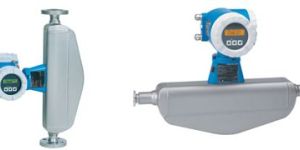
In a Coriolis mass flowmeter, the “swinging” is generated by vibrating the tube(s) in which the fluid flows. The amount of twist is proportional to the mass flow rate of fluid passing through the tube(s). Sensors and a Coriolis mass flowmeter transmitter are used to measure the twist and generate a linear flow signal.Coriolis Mass Flow meters are specially designed and manufactured to meet the demands of difficult applications. These flow meters are available for measuring mass flow and density of liquids, slurries and gases. They use the Coriolis force for direct mass flow measurement of any fluid. Since mass is measured directly, no calculations involving density or volume are required. Measurements are thus immune to variations in pressure, temperature, density, viscosity, electrical conductivity or the presence of gas bubbles or solid particles in the fluid medium.Simultaneous direct measurement of Mass Flow, Density and Temperature with volume, concentration, Brix & Baume as derived parameters are available as standard features, and upto 3 current outputs as an option.
This flowmeter can be applied to sanitary, cryogenic, relatively clean, and corrosive liquids and gases/vapors in pipes smaller than 3/8” - 12 inches.
General applications are found in the water, wastewater, mining, mineral processing, power, pulp and paper, petroleum, chemical, and petrochemical industries.
Virtually all fluids can be measured: cleaning agents and solvents, fuels, vegetable oils, animal fats, latex, silicon oils, alcohol, fruit solutions, toothpaste, vinegar, ketchup, mayonnaise, gases, liquefied gases, etc.
Coriolis mass flowmeters have also been developed for specialized applications such as for the custody transfer of high-pressure natural gas.
High-temperature version up to 350 °C (660 °F)
Ex-Approvals: ATEX, FM, CSA, TIIS, IECEx, NEPSI
Tube material: Stainless Steel, Zirconium, Tantal, Alloy C-22, Titanium
...more





 Reviews & Ratings
 Write a Review


 Post Free Ad