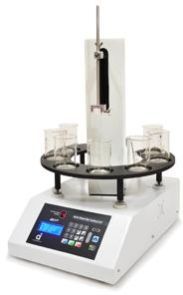
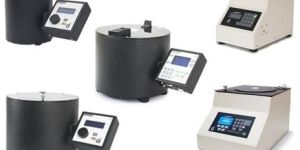
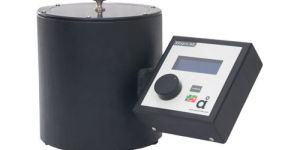
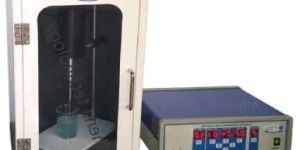
Spin Coating Systems are widely used to create uniform Thin Films of various materials, often polymers, onto the surface of a substrate by employing the concept of centrifugal force.
The high speed and duration range allow the user to achieve the desired thickness or thinness of the film. Acceleration too, is one of the major determinants of the process. As spin coating uses centrifugal force, it is of crucial importance to accurately set the parameters for spin coating.
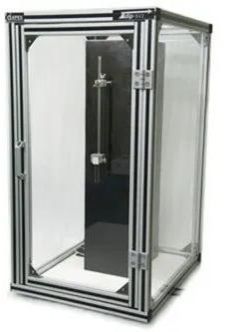
Dip coating refers to the immersing of a substrate into a tank containing coating material, removing the piece from the tank, and allowing it to drain. The coated piece can then be dried by force-drying or baking. It is a popular way of creating thin film coated materials along with the spin coating procedure. Owing to its simplicity, this method lends itself to automation. Film thickness is controlled by coating viscosity and rate of withdrawal from the tank. Dip tanks come in all shapes and are sized to accommodate the largest object to be coated.
Dip Coating Systems are very useful instruments for Fabricating & Characterizing Self-assembled Structures. Formation of Multi-layer Thin Films is also possible with Apex Dip Coating Systems.
Apex introduces Static Contact Angle Measuring System ACAM-S1, where Contact Angle can be measured precisely with Sessile Drop Technique and analyzed accurately with Five Different Analysis Methods viz., Half-angle Fitting, Circle Fitting, Ellipse Fitting and Tangent Fitting Analysis Methods. The contact angle is one of the most common ways of measuring the wettability of a surface. Wettability refers to how a liquid is deposited on a solid surface spreads out. It is determined by measuring the angle created when a liquid comes into contact with a solid surface.
Secondary Business TypeManufacturer / Exporters / Wholesale Suppliers
Opening Hours
SUN : Closed
MON : 9:30 AM - 6:30 PM
TUE : 9:30 AM - 6:30 PM
WED : 9:30 AM - 6:30 PM
THU : 9:30 AM - 6:30 PM
FRI : 9:30 AM - 6:30 PM
SAT : 9:30 AM - 6:30 PM
Founded in the year 1991, in Kolkata, India, Apex has pioneered the field of Thin Film Laboratory Solution. The Company provides a number of leading-edge technologies and solutions for Thin Film Laboratories. By combining science and advanced technologies, Apex has been creating a wide range of products to support the researchers in the field of Nano-thin Film Research Applications. In the early 80’s Pijush Roychowdhury was an employee of Advanced Centre for Cryogenic Research housed in Jadavpur University campus, there he met two distinguished personalities Ranajit Saha an instrumentalist and Dr. Gautam Buddha Talapatra a scientist. They both hailed from Indian Association for the Cultivation of Science. Dr. Talapatra had just returned from USA after completing his post doctorate commitments and was fresh with some ideas to developsome scientific instruments in our country. “Excellence is a continuous process and not an accident” Pijush took the initiative and three persons joined their hands together and a journey started towards quenching their thirst of exploring new technologies and managed to develop a Cryogenic Freezer for Cryopreservation of any biological material. This instrument was first of its kind in India.