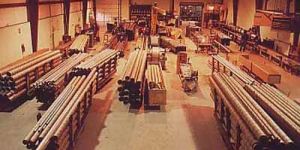
Western Pneumatic Tube Company is a custom, welded tube mill capable of producing specialty tubing in a wide variety of materials and configurations. At the same time, it is a production facility with capacity for output of tubing of certified quality and integrity.
The capability of manufacturing highly specialized tubing to aerospace and laboratory tolerance aswell as the capacity for volume production, provides the moans for flexible and efficient response to a broad range of industry requirements.
Features :
Our unique capabilities are based on a combination of forming and welding techniques. specifically designed equipment to meet your special production requirements, and on capable people with years of experience in welded tube production.
Three basic welding techniques, each contributing unique capabilities and advantages, are employed at Western Pneumatic.
Continuous mill forming and welding of stainless steel hollows in a range of diameters of 2 3/8 to 4 1/2 in wall thicknesses of .035" to .120
Semi-continuous ring forming and welding for custom production of high volumes of thin wall tubing in diameters of ?e to 12" with wall thicknesses of .004 to .05Q and in lengths to 40 ft
Brake forming for subsequent welding of individual tube lengths in materials. gauges, sizes or quantities not suited to the higher production methods. Tubing from 4:i to 10' in diameter, in wall thickness to .150-can be produced
Other facilities include hydraulic draw benches for cold drawing, resizing, or shaping to an unlimited variety of cross-sectional shapes
Western Pneumatic Tube Company is a custom, welded tube mill capable of producing specialty tubing in a wide variety of materials and configurations. At the same time, it is a production facility with capacity for output of tubing of certified quality and integrity.
The capability of manufacturing highly specialized tubing to aerospace and laboratory tolerance aswell as the capacity for volume production, provides the moans for flexible and efficient response to a broad range of industry requirements.
Features :
Our unique capabilities are based on a combination of forming and welding techniques. specifically designed equipment to meet your special production requirements, and on capable people with years of experience in welded tube production.
Three basic welding techniques, each contributing unique capabilities and advantages, are employed at Western Pneumatic.
Continuous mill forming and welding of stainless steel hollows in a range of diameters of 2 3/8 to 4 1/2 in wall thicknesses of .035" to .120
Semi-continuous ring forming and welding for custom production of high volumes of thin wall tubing in diameters of ?e to 12" with wall thicknesses of .004 to .05Q and in lengths to 40 ft
Brake forming for subsequent welding of individual tube lengths in materials. gauges, sizes or quantities not suited to the higher production methods. Tubing from 4:i to 10' in diameter, in wall thickness to .150-can be produced
Other facilities include hydraulic draw benches for cold drawing, resizing, or shaping to an unlimited variety of cross-sectional shapes
PEM brand weld nuts overcome many problems associated with other weld nuts - burn-outs, complicated electrodes and pilots, tedious time-consuming indexing and re-tapping to remove weld spatter. Their design, based on the experience of hundreds of users of weld nuts, speeds production using standard equipment, thereby reducing labor costs.
PEM brand weld nuts overcome many problems associated with other weld nuts - burn-outs, complicated electrodes and pilots, tedious time-consuming indexing and re-tapping to remove weld spatter. Their design, based on the experience of hundreds of users of weld nuts, speeds production using standard equipment, thereby reducing labor costs.
SI®THREADED INSERTS PLASTICS
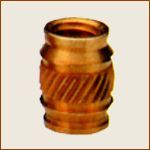
SI inserts are typically specified in applications where strong, durable metal threads are required in plastic material, especially where frequent assembly and disassembly of the unit for service or repair is necessary.
Applications for SI® products include: computers and terminal boards, automotive, electronic equipment, business machines, aerospace, communications equipment and instrument cases. • SI inserts are available in brass, stainless steel and aluminum.
SI inserts are available in a large variety of ultrasonic / heat staking, molded-in or press-in types.
SI inserts meet the strictest quality guidelines which are maintained through in-process audits and adherence to the ISO 9001 and QS-9000 disciplines.
Features :
ULTRASONIC / HEAT STAKING INSERTS
Ultrasonic - Installed by pressing the insert into the mounting hole with ultrasonic insertion equipment while simultaneously applying a high frequency vibration. Frictional heat caused by the vibration melts the plastic surrounding the insert allowing easy insertion. When the vibration ceases, the plastic solidifies, locking the insert permanently in place.
Heat Staking - Installed by pressing the insert into the mounting hole with a thermal press to melt the plastic surrounding the insert.
MOLDED-IN INSERTS
Installed during the molding process, the inserts are located in the mold cavity by core pins. When the mold opens, the core pins are withdrawn leaving the inserts permanently encapsulated in the plastic section with only the threads exposed.
Installing the inserts during the molding process eliminates the need for secondary steps or installation equipment.
PRESS-IN INSERTS
nstalled by simply pressing the inserts into pre-molded or drilled holes. Installation is accomplished using any standard press at any time during the production process.
Eliminates the need for molding-in inserts.
Eliminates the need for heat or ultrasonic equipment
SI®THREADED INSERTS PLASTICS
SI inserts are typically specified in applications where strong, durable metal threads are required in plastic material, especially where frequent assembly and disassembly of the unit for service or repair is necessary.
Applications for SI® products include: computers and terminal boards, automotive, electronic equipment, business machines, aerospace, communications equipment and instrument cases. • SI inserts are available in brass, stainless steel and aluminum.
SI inserts are available in a large variety of ultrasonic / heat staking, molded-in or press-in types.
SI inserts meet the strictest quality guidelines which are maintained through in-process audits and adherence to the ISO 9001 and QS-9000 disciplines.
Features :
ULTRASONIC / HEAT STAKING INSERTS
Ultrasonic - Installed by pressing the insert into the mounting hole with ultrasonic insertion equipment while simultaneously applying a high frequency vibration. Frictional heat caused by the vibration melts the plastic surrounding the insert allowing easy insertion. When the vibration ceases, the plastic solidifies, locking the insert permanently in place.
Heat Staking - Installed by pressing the insert into the mounting hole with a thermal press to melt the plastic surrounding the insert.
MOLDED-IN INSERTS
Installed during the molding process, the inserts are located in the mold cavity by core pins. When the mold opens, the core pins are withdrawn leaving the inserts permanently encapsulated in the plastic section with only the threads exposed.
Installing the inserts during the molding process eliminates the need for secondary steps or installation equipment.
PRESS-IN INSERTS
nstalled by simply pressing the inserts into pre-molded or drilled holes. Installation is accomplished using any standard press at any time during the production process.
Eliminates the need for molding-in inserts.
Eliminates the need for heat or ultrasonic equipment
THE STICKSCREW® SYSTEM
The StickScrew® system offers manufacturers an extremely fast, accurate and efficient method of small screw insertion. The new and improved StickShooter® driver is designed to accommodate interchangeable nose assemblies.
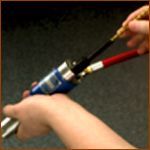
This simple, low cost system combines a lightweight driver and "sticks" of up to 130 per 12" serially connected hex head screws. Simply insert the stick in the driver, advance to the second screw, squeeze the trigger, place the tip of the rotating screw into the hole and the screw is driven home, twisting off cleanly when precise seating torque is reached.
Custom screw designs, finishes, and coatings are available to meet the needs of specific applications.
Features :
The StickScrew® system benefits include:
Self-contained system. No expensive tooling, jigs, or fixtures are required.
Designed to reduce repetitive motion stress injury. Eliminates manual driving of screws.
Torque reliability. Seating torque is built into the screw eliminating torque testing and ensuring the assembly is properly fastened.
Minimum operator training. System can be applied to your production line with less than ten minutes training
Inventory control simplified. No loose or mixed screws. Less shelf space required.
Major productivity increase in small screw insertion. Productivity increases are greater as screw diameters decrease since difficulty in handling loose screws is eliminated.
Interchangeable nose assemblies enable quick tooling changeover for all screw hex sizes.
THE STICKSCREW® SYSTEM
The StickScrew® system offers manufacturers an extremely fast, accurate and efficient method of small screw insertion. The new and improved StickShooter® driver is designed to accommodate interchangeable nose assemblies.
This simple, low cost system combines a lightweight driver and "sticks" of up to 130 per 12" serially connected hex head screws. Simply insert the stick in the driver, advance to the second screw, squeeze the trigger, place the tip of the rotating screw into the hole and the screw is driven home, twisting off cleanly when precise seating torque is reached.
Custom screw designs, finishes, and coatings are available to meet the needs of specific applications.
Features :
The StickScrew® system benefits include:
Self-contained system. No expensive tooling, jigs, or fixtures are required.
Designed to reduce repetitive motion stress injury. Eliminates manual driving of screws.
Torque reliability. Seating torque is built into the screw eliminating torque testing and ensuring the assembly is properly fastened.
Minimum operator training. System can be applied to your production line with less than ten minutes training
Inventory control simplified. No loose or mixed screws. Less shelf space required.
Major productivity increase in small screw insertion. Productivity increases are greater as screw diameters decrease since difficulty in handling loose screws is eliminated.
Interchangeable nose assemblies enable quick tooling changeover for all screw hex sizes.
PEM® ReelFast® surface mount nuts, spacers, panel fasteners and R'ANGLE®fasteners are mounted to printed circuit boards in the same manner as other surface mount components prior to the solder reflow process. The fasteners are provided on tape and reel compatible with existing SMT automated installation equipment. Nuts and spacers are available in threaded and unthreaded sizes.
Features :
Benefits of ReelFast® SMT fasteners are:
Faster assembly
Reduced scrap
Reduced handling
Reduced risk of board damage that may occur when fasteners are improperly installed with off-line equipment
Reduced loose hardware
PEM® ReelFast® surface mount nuts, spacers, panel fasteners and R'ANGLE®fasteners are mounted to printed circuit boards in the same manner as other surface mount components prior to the solder reflow process. The fasteners are provided on tape and reel compatible with existing SMT automated installation equipment. Nuts and spacers are available in threaded and unthreaded sizes.
Features :
Benefits of ReelFast® SMT fasteners are:
Faster assembly
Reduced scrap
Reduced handling
Reduced risk of board damage that may occur when fasteners are improperly installed with off-line equipment
Reduced loose hardware
KEYHOLE® STANDOFFS SELF CLINCHING
The PEM KEYHOLE® Standoff (Type SKC®) is designed so that a PC board or panel can be quickly slipped into place and then removed from an assembly by simply sliding the board sideways and lifting it off. PEM Keyhole standoffs can save valuable time and dramatically reduce the amount of loose hardware required.
Features :
These standoffs can be used for spacing or hanging of replaceable components.
Typically, several KEYHOLE standoffs are used with one standard PEM threaded standoff which accepts a screw to secure the board or component
KEYHOLE® STANDOFFS SELF CLINCHING
The PEM KEYHOLE® Standoff (Type SKC®) is designed so that a PC board or panel can be quickly slipped into place and then removed from an assembly by simply sliding the board sideways and lifting it off. PEM Keyhole standoffs can save valuable time and dramatically reduce the amount of loose hardware required.
Features :
These standoffs can be used for spacing or hanging of replaceable components.
Typically, several KEYHOLE standoffs are used with one standard PEM threaded standoff which accepts a screw to secure the board or component
Aluminum Printed Circuit Boards(III)
Standard and Custom Aluminum Extruded Front Panels and Faceplates Our comprehensive range of solutions delivers industry leading value
Put Your Best Face Forward
Baknor is your first choice in high quality, standard and custom stamped, extruded or cast front panels and faceplates offering a comprehensive range of solutions with industry leading value.
From simple metal components to detailed cosmetic parts, Baknor ensures your best face is always brought forward.
By delivering rugged product quality through precision tooling design, process engineering and documented quality control, Baknor offers front panels and face plates for virtually any electronics applications.
Features :
Quick reponse to your needs
Creative design solutions
Cost advantages
Localized inventory management
Aggressively pursue price and technolgy improvements
Prototyping - Fast and Accurate
Baknor has built an enviable reputation for expert prototyping that is fast and accurate. Our prototyping - system provides the assurance you need that the design will function perfectly. Our ability to turn your prototypes into production - from very small volume requirements to high production needs with our complete and systematic prototyping process is proven to deliver results, fast.
Insight,Creativity And Esthetics
Improve the looks and feel og your faceplates by taking advantage of Baknor's comprehensive manufacturing capabilities and high quality finishes. We can include numerous features into the design that will help your customers identify your brand. Include offsets for shielding strips or clips, square corners, detents for a variety of custom labels, or where ever our creativity may take you. And with numerous variations on cut outs for switches, connectors and LEDs, we can provide you with that special look.
Aluminum Printed Circuit Boards(III)
Standard and Custom Aluminum Extruded Front Panels and Faceplates Our comprehensive range of solutions delivers industry leading value
Put Your Best Face Forward
Baknor is your first choice in high quality, standard and custom stamped, extruded or cast front panels and faceplates offering a comprehensive range of solutions with industry leading value.
From simple metal components to detailed cosmetic parts, Baknor ensures your best face is always brought forward.
By delivering rugged product quality through precision tooling design, process engineering and documented quality control, Baknor offers front panels and face plates for virtually any electronics applications.
Features :
Quick reponse to your needs
Creative design solutions
Cost advantages
Localized inventory management
Aggressively pursue price and technolgy improvements
Prototyping - Fast and Accurate
Baknor has built an enviable reputation for expert prototyping that is fast and accurate. Our prototyping - system provides the assurance you need that the design will function perfectly. Our ability to turn your prototypes into production - from very small volume requirements to high production needs with our complete and systematic prototyping process is proven to deliver results, fast.
Insight,Creativity And Esthetics
Improve the looks and feel og your faceplates by taking advantage of Baknor's comprehensive manufacturing capabilities and high quality finishes. We can include numerous features into the design that will help your customers identify your brand. Include offsets for shielding strips or clips, square corners, detents for a variety of custom labels, or where ever our creativity may take you. And with numerous variations on cut outs for switches, connectors and LEDs, we can provide you with that special look.
PEM brand weld nuts overcome many problems associated with other weld nuts - burn-outs, complicated electrodes and pilots, tedious time-consuming indexing and re-tapping to remove weld spatter. Their design, based on the experience of hundreds of users of weld nuts, speeds production using standard equipment, thereby reducing labor costs.PEM stainless steel weld nuts offer the added advantages of resisting corrosion and being essentially non-magnetic. You may specify steel or stainless steel for your requirements and be sure you are getting the weld nuts that are easiest to install.
PEM brand weld nuts overcome many problems associated with other weld nuts - burn-outs, complicated electrodes and pilots, tedious time-consuming indexing and re-tapping to remove weld spatter. Their design, based on the experience of hundreds of users of weld nuts, speeds production using standard equipment, thereby reducing labor costs.PEM stainless steel weld nuts offer the added advantages of resisting corrosion and being essentially non-magnetic. You may specify steel or stainless steel for your requirements and be sure you are getting the weld nuts that are easiest to install.
Replaces riveting or welding.
No special installation equipment required.
Standard parts install into sheets as thin as .030"/0.8mm.
Flush mounted on both sides.
Minimal space requirements.
Can be installed blind into bottom (panel 2) sheet.
Can join dissimilar metals (which otherwise can not be welded).
Can be concealed with paints and powder coatings.
Can be used as single flush-mounted pivot point.
RoHS compliant.
Features :
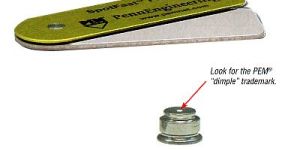
The PEM® SpotFast™ self-clinching fastener from PennEngineering creates a permanent, flush joining of two sheets of metal. The fastener installs smooth with the top sheet, and flush or sub-flush with the bottom sheet. Squeezing the fastener into place causes a cold-flow of panel material into the fastener's two separate clinch profiles. This fastener is capable of joining two dissimilar metals, including unequal thicknesses. Rotational by design, the use of a single fastener can also act as a hardened pivot point if so desired.
Replaces riveting or welding.
No special installation equipment required.
Standard parts install into sheets as thin as .030"/0.8mm.
Flush mounted on both sides.
Minimal space requirements.
Can be installed blind into bottom (panel 2) sheet.
Can join dissimilar metals (which otherwise can not be welded).
Can be concealed with paints and powder coatings.
Can be used as single flush-mounted pivot point.
RoHS compliant.
Features :
The PEM® SpotFast™ self-clinching fastener from PennEngineering creates a permanent, flush joining of two sheets of metal. The fastener installs smooth with the top sheet, and flush or sub-flush with the bottom sheet. Squeezing the fastener into place causes a cold-flow of panel material into the fastener's two separate clinch profiles. This fastener is capable of joining two dissimilar metals, including unequal thicknesses. Rotational by design, the use of a single fastener can also act as a hardened pivot point if so desired.
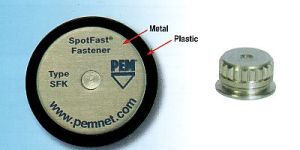
for joining metal to PCB/plastic panels
The PEMa SpotFast° fastener from PennEngineering" creates a permanent, flush joining of metal to PCB/plastic
Features :
Features and Benefits
Alternative to riveting and adhesives
Standard parts install into metal sheets as thin as .031 "/0.8mm
for joining metal to PCB/plastic panels
The PEMa SpotFast° fastener from PennEngineering" creates a permanent, flush joining of metal to PCB/plastic
Features :
Features and Benefits
Alternative to riveting and adhesives
Standard parts install into metal sheets as thin as .031 "/0.8mm
washer allows consistent pivoting of two metal panels
The PEM SpotFast' self clinching fastener from Pennfngineering' allows pivoting of two sheets of metal. A wave washer provides the consistent torsion to allow repeatable hinging. The fastener installs smooth with the top sheet, and flush or sub-flush with the bottom sheet. Squeezing the fastener into place causes a cold-flow of panel material into the fastener's two separate clinch profiles. This fastener is capable of joining two dissimilar metals, including unequal thicknesses.
Features :
Features and Benefits
Alternative to riveting
Washer allows pivoting with consistent force
Standard parts install into sheets as thin as .031"/0.8mm
Flush mounted
Minimal space requirements
Can be installed blind into bottom (Panel 2) panel
Can join dissimilar metals
RoHS compliant
Installations
Punch or drill properly sized mounting hole in both panels. Do not perform any secondary operations such as deburring
Using only Panel 1, with the punch and anvil surfaces parallel, apply squeezing force until the fastener is flush with the top of Panel 1
Place washer over installed fastener (concave side facing up), then place Panel 2 over fastener. Apply squeezing force. Keep .015-.020" / 0.38-0.51 mm nominal gap between two sheets after installation
Part Number Designation
Performanes Data
washer allows consistent pivoting of two metal panels
The PEM SpotFast' self clinching fastener from Pennfngineering' allows pivoting of two sheets of metal. A wave washer provides the consistent torsion to allow repeatable hinging. The fastener installs smooth with the top sheet, and flush or sub-flush with the bottom sheet. Squeezing the fastener into place causes a cold-flow of panel material into the fastener's two separate clinch profiles. This fastener is capable of joining two dissimilar metals, including unequal thicknesses.
Features :
Features and Benefits
Alternative to riveting
Washer allows pivoting with consistent force
Standard parts install into sheets as thin as .031"/0.8mm
Flush mounted
Minimal space requirements
Can be installed blind into bottom (Panel 2) panel
Can join dissimilar metals
RoHS compliant
Installations
Punch or drill properly sized mounting hole in both panels. Do not perform any secondary operations such as deburring
Using only Panel 1, with the punch and anvil surfaces parallel, apply squeezing force until the fastener is flush with the top of Panel 1
Place washer over installed fastener (concave side facing up), then place Panel 2 over fastener. Apply squeezing force. Keep .015-.020" / 0.38-0.51 mm nominal gap between two sheets after installation
Part Number Designation
Performanes Data
Permanently captivates into sheets as thin as.040" 11.02 mm and greater.
Replaces loose hardware
Available with jacking feature or axial float feature.
Appropriate for close centerline-to-edge applications
RoHS compliant
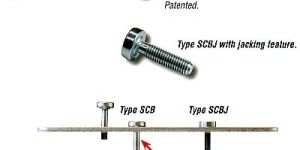
Type SCB'"' Spinning Clinch Bolt is a one piece fastener that installs by simply pressing it into a properly sized hole. The controlled clinching action permanently captivates the screw in the panel yet still leaves it to spin freely in the sheet. This allows quick attachment of mating hardware, eliminating much of the need for loose fasteners, such as screws and retaining clips or washers. or expensive multi-component fastener assemblies.
The Spinning Clinch Bolt can also be used with the PEM Type N10 receptacle nut (see PEM Bulletin PF) and with the PEM Type RAS R'ANGLEg fastener .
Part Number Designation
All dimensions are in inches
All dimensions are in millimeters
Features :
Installation
Punch or drill properly sized mounting hole in sheet
Place the fastener through mounting hole and into anvil. A flat or recessed punch can be used
With punch and anvil surfaces parallel, apply squeezing force to the top of the screw head and the underside of the sheet material. The squeezing action forces the shoulder of the screw into the sheet, displacing sheet material, causing it to fill the void under the head and shoulder of the screw
All dimensions are in inches
All dimensions are in millimeters
Performanes Data
Permanently captivates into sheets as thin as.040" 11.02 mm and greater.
Replaces loose hardware
Available with jacking feature or axial float feature.
Appropriate for close centerline-to-edge applications
RoHS compliant
Type SCB'"' Spinning Clinch Bolt is a one piece fastener that installs by simply pressing it into a properly sized hole. The controlled clinching action permanently captivates the screw in the panel yet still leaves it to spin freely in the sheet. This allows quick attachment of mating hardware, eliminating much of the need for loose fasteners, such as screws and retaining clips or washers. or expensive multi-component fastener assemblies.
The Spinning Clinch Bolt can also be used with the PEM Type N10 receptacle nut (see PEM Bulletin PF) and with the PEM Type RAS R'ANGLEg fastener .
Part Number Designation
All dimensions are in inches
All dimensions are in millimeters
Features :
Installation
Punch or drill properly sized mounting hole in sheet
Place the fastener through mounting hole and into anvil. A flat or recessed punch can be used
With punch and anvil surfaces parallel, apply squeezing force to the top of the screw head and the underside of the sheet material. The squeezing action forces the shoulder of the screw into the sheet, displacing sheet material, causing it to fill the void under the head and shoulder of the screw
All dimensions are in inches
All dimensions are in millimeters
Performanes Data
Improved torque out resistance
Easy to install using spin/spin tooling
Able to be installed after finish
Features a large diameter, low-profile head and knurled shank
Offers highest all around strength
Same as the AEL but with a minimized-profile head
Allows near-flush installations with no need for special hole preparations such as countersinking or dimpling
Features :
Features Low-Profile head design
Achieves flush installations with no need for counter-sink drilling or dimpling of the parent material
Works in any thickness over .029'%0.76 mm including blind hole
High resistance to torque out
Minimal backside protrusion for restricted space applications
Provide strong external threads in blind applications
Easy to install using spin/spin tooling
Improved torque out resistance
Easy to install using spin/spin tooling
Able to be installed after finish
Features a large diameter, low-profile head and knurled shank
Offers highest all around strength
Same as the AEL but with a minimized-profile head
Allows near-flush installations with no need for special hole preparations such as countersinking or dimpling
Features :
Features Low-Profile head design
Achieves flush installations with no need for counter-sink drilling or dimpling of the parent material
Works in any thickness over .029'%0.76 mm including blind hole
High resistance to torque out
Minimal backside protrusion for restricted space applications
Provide strong external threads in blind applications
Easy to install using spin/spin tooling
SCREWS are basically classified under 3 major types or categories:
MACHINE SCREWS - needs a pre-tapped hole - most commonly used
TAPPING SCREWS - needs the hole to be drilled pierced, but not tapped - typical types are taptite screws (used on soft metal or casting), plastite screws (used for plastic) or High-Low screws (normally used on sheet metal). - need to specify the type of point for leading the screw into the hole e.g. type BT, type C or F „
DRILLING SCREWS - do not need a hole (but for positional accuracy, a pilot point is recommended) - typically used in construction industries - drilling screws consists of a drill bit tip followed by a tapping screw body. - eliminates the need to bring work piece to the drill bench to prepare hole.
A SEM is an assembly consisting of a screw with one or more washers.
Features :
How to specify a screw (basic requirement)
Head type e.g. Pan head
Type of drive e.g. Cross Recess
Thread used e.g. M3 or 6-32
Length needed e.g. 10 mm or 0.5" (note: do not mix metric length and unified thread sizes)
Type of screw e.g. taptite or machine screws or a SEM
Material used e.g. Low carbon steel (LCS)
Plating (if any) e.g. zinc clear
Optional :
Standards e.g. JIS or IFI
Note: In all preparation, the precedence priority in terms of quality definition, the following order is adopted:
First article approval documentation (which may include deviations)
Print or Drawing specifications
Part description d. Samples
SCREWS are basically classified under 3 major types or categories:
MACHINE SCREWS - needs a pre-tapped hole - most commonly used
TAPPING SCREWS - needs the hole to be drilled pierced, but not tapped - typical types are taptite screws (used on soft metal or casting), plastite screws (used for plastic) or High-Low screws (normally used on sheet metal). - need to specify the type of point for leading the screw into the hole e.g. type BT, type C or F „
DRILLING SCREWS - do not need a hole (but for positional accuracy, a pilot point is recommended) - typically used in construction industries - drilling screws consists of a drill bit tip followed by a tapping screw body. - eliminates the need to bring work piece to the drill bench to prepare hole.
A SEM is an assembly consisting of a screw with one or more washers.
Features :
How to specify a screw (basic requirement)
Head type e.g. Pan head
Type of drive e.g. Cross Recess
Thread used e.g. M3 or 6-32
Length needed e.g. 10 mm or 0.5" (note: do not mix metric length and unified thread sizes)
Type of screw e.g. taptite or machine screws or a SEM
Material used e.g. Low carbon steel (LCS)
Plating (if any) e.g. zinc clear
Optional :
Standards e.g. JIS or IFI
Note: In all preparation, the precedence priority in terms of quality definition, the following order is adopted:
First article approval documentation (which may include deviations)
Print or Drawing specifications
Part description d. Samples
PEM®SNAP TOP STANDOFFS
PEM SNAP-TOP® Standoffs (Types SSA, SSS, SSC, KSSB) are designed for permanent installation into metal panels or PC boards.
These all-metal standoffs use a spring action to hold PC boards and subassemblies securely, while allowing for quick removal. Screws and other threaded hardware are eliminated. This means less parts to handle during assembly and less risk of damaging delicate circuitry because of loose parts falling into your equipment.
Features :
These standoffs are permanently installed in the panel by squeezing them into a punched or drilled hole using any standard press. Installation forces, pushout, and snap forces, are listed on page 6.
PEM®SNAP TOP STANDOFFS
PEM SNAP-TOP® Standoffs (Types SSA, SSS, SSC, KSSB) are designed for permanent installation into metal panels or PC boards.
These all-metal standoffs use a spring action to hold PC boards and subassemblies securely, while allowing for quick removal. Screws and other threaded hardware are eliminated. This means less parts to handle during assembly and less risk of damaging delicate circuitry because of loose parts falling into your equipment.
Features :
These standoffs are permanently installed in the panel by squeezing them into a punched or drilled hole using any standard press. Installation forces, pushout, and snap forces, are listed on page 6.
PEM®self-locking fasteners (Type LK/LKS/LKA) permanently retain their inherent flexing action, permitting
repeated use and effective prevailing locking torque.
The unique PEMFLEX® self-locking feature with EF or MD finishes, meet the locking torque requirements for 250°F nuts of NASM25027 specification. The self-clinching feature is the same tried and proven design preferred and appreciated for fast, simple assembly. These fasteners do not protrude through the reverse side of the sheet and provide positive, permanent attachment with high torque-out (many times greater than locking torque) and pushout resistances.
Features :
PEM all-metal, self-locking fasteners are available in steel, stainless steel, and aluminum. Types LK (steel) and LKS (stainless) are treated with a black dry film lubricant for better locking performance. Type LKA (aluminum) must be used with a lubricated screw. The PEM design utilizes two rugged, semicircular flexing jaws instead of several less-supported segments. The greater ruggedness and retention of this PEMFLEX action prevents relaxation and loosening of the fastener in severe service.
PEM®self-locking fasteners (Type LK/LKS/LKA) permanently retain their inherent flexing action, permitting
repeated use and effective prevailing locking torque.
The unique PEMFLEX® self-locking feature with EF or MD finishes, meet the locking torque requirements for 250°F nuts of NASM25027 specification. The self-clinching feature is the same tried and proven design preferred and appreciated for fast, simple assembly. These fasteners do not protrude through the reverse side of the sheet and provide positive, permanent attachment with high torque-out (many times greater than locking torque) and pushout resistances.
Features :
PEM all-metal, self-locking fasteners are available in steel, stainless steel, and aluminum. Types LK (steel) and LKS (stainless) are treated with a black dry film lubricant for better locking performance. Type LKA (aluminum) must be used with a lubricated screw. The PEM design utilizes two rugged, semicircular flexing jaws instead of several less-supported segments. The greater ruggedness and retention of this PEMFLEX action prevents relaxation and loosening of the fastener in severe service.
PEM® weld nuts (Types WN/WNS) provide load-bearing threads in metal sheets too thin to tap, and permit faster assembly.
PEM brand weld nuts overcome many problems associated with other weld nuts - burn-outs, complicated electrodes and pilots, tedious time-consuming indexing and re-tapping to remove weld spatter. Their design, based on the experience of hundreds of users of weld nuts, speeds production using standard equipment, thereby reducing labor costs.
Features :
PEM stainless steel weld nuts offer the added advantages of resisting corrosion and being essentially non-magnetic. You may specify steel or stainless steel for your requirements and be sure you are getting the weld nuts that are easiest to install.
A variety of welding equipment is suitable for installation of PEM weld nuts. Best results have been obtained with a 50KVA press-type, spot-welding machine whose upper welding head moves vertically in a straight line with the lower electrode. Flat-faced electrodes with tip diameters .125" / 3.2 mm larger than the "E" dimension of the PEM weld nut should be used.
PEM® weld nuts (Types WN/WNS) provide load-bearing threads in metal sheets too thin to tap, and permit faster assembly.
PEM brand weld nuts overcome many problems associated with other weld nuts - burn-outs, complicated electrodes and pilots, tedious time-consuming indexing and re-tapping to remove weld spatter. Their design, based on the experience of hundreds of users of weld nuts, speeds production using standard equipment, thereby reducing labor costs.
Features :
PEM stainless steel weld nuts offer the added advantages of resisting corrosion and being essentially non-magnetic. You may specify steel or stainless steel for your requirements and be sure you are getting the weld nuts that are easiest to install.
A variety of welding equipment is suitable for installation of PEM weld nuts. Best results have been obtained with a 50KVA press-type, spot-welding machine whose upper welding head moves vertically in a straight line with the lower electrode. Flat-faced electrodes with tip diameters .125" / 3.2 mm larger than the "E" dimension of the PEM weld nut should be used.
FH (flush-head) Studs are installed by placing them in punched or drilled holes in the sheets and squeezing into place with any standard press. The squeezing action embeds the head of the stud into the sheet. The metal displaced by the head flows smoothly and evenly around the ribs and into the annular groove - creating a flush-head assembly and securely locking the stud into the sheet with high torque-out and pushout resistances.. Also available unthreaded on special order.
Features :
TFH (non-flush) Studs are for sheets as thin as .020 inches / 0.51 mm. They may also be used in thicker sheets where flush head studs are not required. TFH studs are installed in the sheets in the same manner as flush-head studs; however, different punches and anvils are required. When installed, the TFH stud will be securely locked into the thin sheet with ample torque-out and pushout resistances. The stud head will not be flush but will project above the sheet surface approximately .025 in. / 0.64 mm.
HFH (high-strength) Studs replace weld studs with easier installation at lower costs. The large stud head which projects above the sheet material distributes the axial tightening force over a large area thereby improving pull through resistance.
HFHB (BUBAR®) Studs are ideal for applications which demand superior electrical/mechanical attachment points. Phosphor bronze studs offer twice the conductivity of carbon steel studs.
FHL (low-displacement head) Studs install closer to the edge of a sheet than standard studs without causing that edge to bulge. Depending on thread size, Type FHL studs can be installed from 25% to 50% closer to the edge of a sheet than standard self-clinching studs.
FH4 & FHP (flush-head) Studs for Sterols Steel are designed to provide strong threads in stainless steel sheets as thin as .040" / 1 mm. Type FHP studs have high corrosion resistance. Both types are designed for use in stainless steel sheets with a hardness of 92 or less on the Rockwell "B" scale.
TPS (flush-head) Pilot Pins satisfy a wide range of positioning, pivot, and alignment applications. The chamfered end makes mating hole location easy.
HFE (high-strength) Studs are designed with an enlarged head diameter to provide high-strength in sheets as thin as .040" / 1 mm.
Dog Point and Anti Cross-Thread Options.
FH (flush-head) Studs are installed by placing them in punched or drilled holes in the sheets and squeezing into place with any standard press. The squeezing action embeds the head of the stud into the sheet. The metal displaced by the head flows smoothly and evenly around the ribs and into the annular groove - creating a flush-head assembly and securely locking the stud into the sheet with high torque-out and pushout resistances.. Also available unthreaded on special order.
Features :
TFH (non-flush) Studs are for sheets as thin as .020 inches / 0.51 mm. They may also be used in thicker sheets where flush head studs are not required. TFH studs are installed in the sheets in the same manner as flush-head studs; however, different punches and anvils are required. When installed, the TFH stud will be securely locked into the thin sheet with ample torque-out and pushout resistances. The stud head will not be flush but will project above the sheet surface approximately .025 in. / 0.64 mm.
HFH (high-strength) Studs replace weld studs with easier installation at lower costs. The large stud head which projects above the sheet material distributes the axial tightening force over a large area thereby improving pull through resistance.
HFHB (BUBAR®) Studs are ideal for applications which demand superior electrical/mechanical attachment points. Phosphor bronze studs offer twice the conductivity of carbon steel studs.
FHL (low-displacement head) Studs install closer to the edge of a sheet than standard studs without causing that edge to bulge. Depending on thread size, Type FHL studs can be installed from 25% to 50% closer to the edge of a sheet than standard self-clinching studs.
FH4 & FHP (flush-head) Studs for Sterols Steel are designed to provide strong threads in stainless steel sheets as thin as .040" / 1 mm. Type FHP studs have high corrosion resistance. Both types are designed for use in stainless steel sheets with a hardness of 92 or less on the Rockwell "B" scale.
TPS (flush-head) Pilot Pins satisfy a wide range of positioning, pivot, and alignment applications. The chamfered end makes mating hole location easy.
HFE (high-strength) Studs are designed with an enlarged head diameter to provide high-strength in sheets as thin as .040" / 1 mm.
Dog Point and Anti Cross-Thread Options.
These standoffs, which use the proven self-clinching design, install with a squeeze in punched or drilled round holes - and become permanently mounted in the thin sheet.
PEM® brand thru-hole threaded standoffs are installed with their heads flush with one surface of the mounting sheet. When blind-threaded types are used, outer sheet surfaces are not only flush, but closed as well. Unthreaded standoffs are also available for spacing multi-panel assemblies.
Types S04 and BSO4 standoffs are for installation into stainless steel sheets as thin as .040" / 1.02 mm. Types TSO, TSOS, and TSOA self-clinching threaded standoffs provide permanent threads in sheets as thin as .025" / 0.63 mm.
PEM self-clinching standoffs are also available on special order in non-heat treated carbon steel as type SON (thru-hole threaded) or BSON (blind threaded).
Types DSO and DSOS standoffs are available for close-to-edge applications. If you require a standoff which we do not offer in this bulletin, please contact us. We will be happy to work with you to satisfy your special need.
Features :
For other types of PENT brand standoffs and spacers see:
Bulletin CH PEM® Concealed-head Standoffs.
Bulletin K PEM® Standoffs for printed circuit boards.
Bulletin SK PEM® KEYHOLE® Standoffs.
Bulletin SMT PEM® ReeIFast SMT Spacers/Nuts.
Bulletin SSA PEM® brand SNAP-TOP® Standoffs.
These standoffs, which use the proven self-clinching design, install with a squeeze in punched or drilled round holes - and become permanently mounted in the thin sheet.
PEM® brand thru-hole threaded standoffs are installed with their heads flush with one surface of the mounting sheet. When blind-threaded types are used, outer sheet surfaces are not only flush, but closed as well. Unthreaded standoffs are also available for spacing multi-panel assemblies.
Types S04 and BSO4 standoffs are for installation into stainless steel sheets as thin as .040" / 1.02 mm. Types TSO, TSOS, and TSOA self-clinching threaded standoffs provide permanent threads in sheets as thin as .025" / 0.63 mm.
PEM self-clinching standoffs are also available on special order in non-heat treated carbon steel as type SON (thru-hole threaded) or BSON (blind threaded).
Types DSO and DSOS standoffs are available for close-to-edge applications. If you require a standoff which we do not offer in this bulletin, please contact us. We will be happy to work with you to satisfy your special need.
Features :
For other types of PENT brand standoffs and spacers see:
Bulletin CH PEM® Concealed-head Standoffs.
Bulletin K PEM® Standoffs for printed circuit boards.
Bulletin SK PEM® KEYHOLE® Standoffs.
Bulletin SMT PEM® ReeIFast SMT Spacers/Nuts.
Bulletin SSA PEM® brand SNAP-TOP® Standoffs.
These standoffs, which use the proven self-clinching design, install with a squeeze in punched or drilled round holes - and become permanently mounted in the thin sheet.
Threaded standoffs are installed with their heads flush with one surface of the mounting sheet. When blind-threaded types are used, outer sheet surfaces are not only flush, but closed as well. Unthreaded standoffs are also available for spacing multi-panel assemblies.
These standoffs, which use the proven self-clinching design, install with a squeeze in punched or drilled round holes - and become permanently mounted in the thin sheet.
Threaded standoffs are installed with their heads flush with one surface of the mounting sheet. When blind-threaded types are used, outer sheet surfaces are not only flush, but closed as well. Unthreaded standoffs are also available for spacing multi-panel assemblies.
SELF-CLINCHING, SHEET JOINING FASTENERS
Allows detachable joining a1 two sheets
Clinch feature mounts fastener permanently into metal sheet
Unique barrel design allows for quick "panel-on-panel" attachment and detachment
Head is flush or sub-flush with one side of metal sheet. Can be clinched into blind hole where concealed-head is required
Makes horizontal or vertical component mounting possible
The PEM KEYHOLES sheet joining fastener. Type SKC-P", is designed so that two sheets can be quickly joined flat against each other and then can be removed from the assembly by simply sliding the sheet sideways and lifting it off.
Typically, several KEYHOLE'S sheet joining fasteners are used with one standard PEW threaded Type F flush nut which accepts a screw to secure the sheets against any unwanted movement
Installations
Punch or drill properly sized mounting hole in Panel
Place the fastener into anvil hole as shown in the drawing to the right
Place the panel over the shank of the fastener
With the punch and anvil surfaces parallel, apply only enough squeezing force until flange is flush with panel
Blind Hole Installation Procedure
Mill a blind hole to .043"/ 1.1mm deep
Place the fastener into anvil hole as shown in the drawing to the right
Place the panel over the shank of the fastener
With the punch and anvil surfaces parallel, apply only enough squeezing force until flange is flush with panel
Features :
All Dimensions are in inches
All dimensions are in millimeters
All Dimensions are in inches
All dimensions are in millimeters
Performances Data
SELF-CLINCHING, SHEET JOINING FASTENERS
Allows detachable joining a1 two sheets
Clinch feature mounts fastener permanently into metal sheet
Unique barrel design allows for quick "panel-on-panel" attachment and detachment
Head is flush or sub-flush with one side of metal sheet. Can be clinched into blind hole where concealed-head is required
Makes horizontal or vertical component mounting possible
The PEM KEYHOLES sheet joining fastener. Type SKC-P", is designed so that two sheets can be quickly joined flat against each other and then can be removed from the assembly by simply sliding the sheet sideways and lifting it off.
Typically, several KEYHOLE'S sheet joining fasteners are used with one standard PEW threaded Type F flush nut which accepts a screw to secure the sheets against any unwanted movement
Installations
Punch or drill properly sized mounting hole in Panel
Place the fastener into anvil hole as shown in the drawing to the right
Place the panel over the shank of the fastener
With the punch and anvil surfaces parallel, apply only enough squeezing force until flange is flush with panel
Blind Hole Installation Procedure
Mill a blind hole to .043"/ 1.1mm deep
Place the fastener into anvil hole as shown in the drawing to the right
Place the panel over the shank of the fastener
With the punch and anvil surfaces parallel, apply only enough squeezing force until flange is flush with panel
Features :
All Dimensions are in inches
All dimensions are in millimeters
All Dimensions are in inches
All dimensions are in millimeters
Performances Data
For load-bearing threads in thin sheets - aluminum, steel, and other ductile materials.
Proved Performance
For over 60 years, PEM brand self-clinching fasteners have satisfied production and fastening requirements wherever load-bearing threads are required in thin metal sections too thin to tap.
Quick, convenient assembly using standard tools
Installation of PEM brand self-clinching nuts is simple, quick, and convenient. Just insert them in punched or drilled holes, then apply a squeezing force to embed the clinching ring completely in the sheet metal.
Features :
High pushout & torque-out resistance
The clinching ring locks the displaced metal behind the tapered shank, ensuring high pushout resistance. High torque-out resistance is ensured when the knurled platform is embedded in the sheet metal.
Distortion-free installation
Proper installation forces will not distort or damage the threads in PEM nuts because the recommended shank length is always less than the minimum sheet thickness.
Reverse side remains flush
All clinching takes place on the fastener side of the sheet. The reverse side remains flush and smooth.
Self-clinching Locknuts
These locknuts (Type SLTM) are designed with a unique and economical TRI-DENT® locking feature, which meets demanding locking performance requirements.
Thin Sheet Self-clinching Nuts
These nuts (Type SMPSTM) feature a lower profile and can be mounted closer to the edge of a sheet than standard self-clinching nuts.
Self-clinching nuts for stainless steel
PEM 300° self-clinching nuts (Type SPTM) are especially designed for permanent installation into stainless steel sheets as thin as .030"/ 0.8 mm.
Machined from a specialty stainless steel, these fasteners are then heat-treated to a hardness higher than most 300 Series stainless steels. This feature enables PEM 300 fasteners to be installed into stainless steel sheets, employing the same self-clinching principle which has proved successful over the years in thousands of applications.
For load-bearing threads in thin sheets - aluminum, steel, and other ductile materials.
Proved Performance
For over 60 years, PEM brand self-clinching fasteners have satisfied production and fastening requirements wherever load-bearing threads are required in thin metal sections too thin to tap.
Quick, convenient assembly using standard tools
Installation of PEM brand self-clinching nuts is simple, quick, and convenient. Just insert them in punched or drilled holes, then apply a squeezing force to embed the clinching ring completely in the sheet metal.
Features :
High pushout & torque-out resistance
The clinching ring locks the displaced metal behind the tapered shank, ensuring high pushout resistance. High torque-out resistance is ensured when the knurled platform is embedded in the sheet metal.
Distortion-free installation
Proper installation forces will not distort or damage the threads in PEM nuts because the recommended shank length is always less than the minimum sheet thickness.
Reverse side remains flush
All clinching takes place on the fastener side of the sheet. The reverse side remains flush and smooth.
Self-clinching Locknuts
These locknuts (Type SLTM) are designed with a unique and economical TRI-DENT® locking feature, which meets demanding locking performance requirements.
Thin Sheet Self-clinching Nuts
These nuts (Type SMPSTM) feature a lower profile and can be mounted closer to the edge of a sheet than standard self-clinching nuts.
Self-clinching nuts for stainless steel
PEM 300° self-clinching nuts (Type SPTM) are especially designed for permanent installation into stainless steel sheets as thin as .030"/ 0.8 mm.
Machined from a specialty stainless steel, these fasteners are then heat-treated to a hardness higher than most 300 Series stainless steels. This feature enables PEM 300 fasteners to be installed into stainless steel sheets, employing the same self-clinching principle which has proved successful over the years in thousands of applications.
Secondary Business TypeManufacturer / Exporters / Wholesale Suppliers
Opening Hours
SUN : Closed
MON : 9:30 AM - 6:30 PM
TUE : 9:30 AM - 6:30 PM
WED : 9:30 AM - 6:30 PM
THU : 9:30 AM - 6:30 PM
FRI : 9:30 AM - 6:30 PM
SAT : 9:30 AM - 6:30 PM
Established in the year 1996, Techtran Electronics (India) Private Limited has grown up to a level in manufacturing, trading and distribution of different fasteners, Aerospace tubing, PCB, Thermal and welding machines. We have presence in all strategic points throughout India and in Singapore to serve over one hundred customers in different segments. Since 1996, we are the Authorized Distributor of Penn Engineering, USA for India and later we have started to represent Western Pneumatic Tube Company, USA and Baknor, Canada for India. We have also collaborated with a world reknown welding machine manufacturer for producing Inverter based welding machines and other types of welding machines for Asia Pacific market. Baknor is well known in manufacturing various ultra thin and Aluminium printed circuit boards, apart from various thermal heat sink products. Western Pneumatic Tube is manufacturing various kinds of Alloy tubes for Aerospace application and other industries for high end specialised application.Our phenomenal growth and niche gives us the status of a most dependable supplier to many MNCs and domestic companies in India as their most coveted source due to our technical and commercial support.







 Reviews & Ratings
 Write a Review


 Post Free Ad