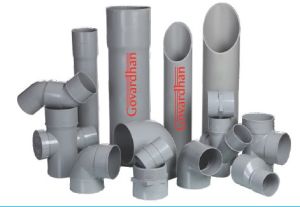
Properties :
Co-efficient of linear expansion : 5.4 x 10 mm/m/ C
Specific gravity : 1.41-1.46 gm/cm
Impact Strength : Complies with IS : 4985 2000
Electrical Resistance : 10 ohm-cm
Vicat softening point : 80 C
Tensile Strength : 500-550 kg/cm
Applications
Industrial ducting
Building Installations
Sewerage & drainage
Gas & Oil supply lines
For slurry disposal lines
Air conditioning ducting
Rural & urban water supply
Agriculture & Irrigation System
Sewerage & industrial effluent disposal
Power and telecommunication cable ducting
Discharge pipes for hospitals & residential buildings
Portable water supplies and drinking water supplies
Plumbing and drainage systems in the dwelling
houses
Lift Irrigation, Bore wells etc. by both Govt. & Farmers
Installation
While designing the pipe line system, the level and depth of the trench is calculated depending on factor such as the terrain and function of the pipeline. Excavation and pipe laying must take place simultaneously, as leaving trenches open for too long, makes them unsuitable for use. A fine layer of sand should be spread on the trench-bed, to avoid mechanical damage arising due to the pipe coming in direct contact with the solid bed. Like wise, it is also recommended to put a fine layer of fine sand on the top of the pipe before filling and carrying the soil to cover the trench. As pipe laying advances, trenches must be backfilled immediately. The pipe joints however should be left exposed till after the pipe line s stem has been tested. The maximum width of the trench must be equal to the pipe diameter plus 300 mm. At the crown of the pipe, the trench width must not exceed the pipe diameter plus 600 mm.