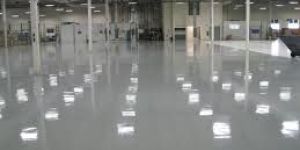
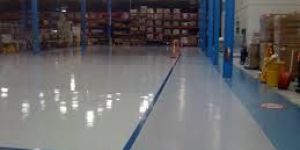
Industrial floors are exposed to traffic, load stress, chemicals, grease and other site conditions that affect the surface quality and, in turn, the working environment. As most industrial floors have a concrete base, they get worn out, contaminated and damaged over time. Epoxy and Polyurethane coatings form a strong, durable and chemically resistant protective layer over the concrete floor. These coatings are formed by a chemical reaction between a resin and hardener.
Industrial floors are exposed to traffic, load stress, chemicals, grease and other site conditions that affect the surface quality and, in turn, the working environment. As most industrial floors have a concrete base, they get worn out, contaminated and damaged over time. Epoxy and Polyurethane coatings form a strong, durable and chemically resistant protective layer over the concrete floor. These coatings are formed by a chemical reaction between a resin and hardener.
The flooring must be able to endure years of heavy industrial machinery, frequent traffic, and load stress. High-strength and durable flooring materials can ensure durable industrial flooring. These materials must withstand temperature changes and are UV resistant in nature, which will render them more versatile flooring materials.
Resilience to impact from machinery and extensive load determines the quality of the flooring. Flooring material with impact resistance, flexibility, and compressive strength function for years together without need for repair.
The flooring must be able to endure years of heavy industrial machinery, frequent traffic, and load stress. High-strength and durable flooring materials can ensure durable industrial flooring. These materials must withstand temperature changes and are UV resistant in nature, which will render them more versatile flooring materials.
Resilience to impact from machinery and extensive load determines the quality of the flooring. Flooring material with impact resistance, flexibility, and compressive strength function for years together without need for repair.
Electrostatic discharge (ESD) can occur on company flooring because of contact, friction, or different materials. On your company flooring, ESD can be caused by the friction while the employees are walking or when transportation such as a forklift is used. During activities, the human body or machinery accumulates charges, termed electrostatic charges. This is when charges caused by friction and the opposite charges accumulated in the employees bodies can collide, resulting in a heavy spark discharge. This could easily damage sensitive machinery and is detrimental to the well being of the employees.
Electrostatic discharge (ESD) can occur on company flooring because of contact, friction, or different materials. On your company flooring, ESD can be caused by the friction while the employees are walking or when transportation such as a forklift is used. During activities, the human body or machinery accumulates charges, termed electrostatic charges. This is when charges caused by friction and the opposite charges accumulated in the employees bodies can collide, resulting in a heavy spark discharge. This could easily damage sensitive machinery and is detrimental to the well being of the employees.
The chief use of sealants is to block the passage of water and gases through gaps between substrates or surfaces. They also help accommodate movement between materials and additionally serve as adhesives. Depending on the intended use, sealants are formulated using different polymers making them strong, rigid or flexible. Sealants can be manufactured to incorporate various properties such as chemical resistance, corrosion resistance and insolubility depending on their intended usage.
The chief use of sealants is to block the passage of water and gases through gaps between substrates or surfaces. They also help accommodate movement between materials and additionally serve as adhesives. Depending on the intended use, sealants are formulated using different polymers making them strong, rigid or flexible. Sealants can be manufactured to incorporate various properties such as chemical resistance, corrosion resistance and insolubility depending on their intended usage.
Secondary Business TypeManufacturer / Exporters / Service Providers / Wholesale Suppliers
Year of Establishment2012
No. of Employees21 - 50
Annual TurnoverBelow Rs. 0.5 Crore Approx.
Ownership TypeCorporation/Limited Liability Company
Opening Hours
SUN : Closed
MON : 9:30 AM - 6:30 PM
TUE : 9:30 AM - 6:30 PM
WED : 9:30 AM - 6:30 PM
THU : 9:30 AM - 6:30 PM
FRI : 9:30 AM - 6:30 PM
SAT : 9:30 AM - 6:30 PM
Angre port is in jaigad harbour , located in the ratnagiri district at latitude 17° 17’ n and longitude 73 ° 14’ e along the southern bank of the shastri river, approximately 110 nm south of mumbai and 126 nm north of goa. The port is fully protected by a land mass from the south- south west monsoon making it an all-weather port. Deep water depths exists in the river channel and approach to the proposed facility, besides which the site has excellent tranquility, critical to smooth flow of operations. Angré port mapangré port will have depths up to -13 cd alongside the berth. The national highway nh 17 and the konkan railway connecting angré port at jaigad are about 45 kms from the proposed site. Apart from this, a four lane road and a dedicated rail link to the port site have been proposed. The convenient location makes it an ideal import and export alternative hub for the fast growing industrial and manufacturing areas of south maharashtra, north karnataka and west andhra pradesh.




 Reviews & Ratings
 Write a Review


 Post Free Ad