igm Roboticsystems India Pvt. Ltd Bhosari, Pune, Maharashtra

  • Workpiece Periphery

    Workpiece Periphery

    Get Latest Price

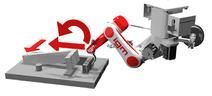
    The workpiece periphery holds, positions, and moves workpieces. The external axes are fully integrated in the control systems as NC axes and, in addition, feature manual control functionality. External axes may be included in workpiece manipulation during execution of welding steps. Using the teach pendant, they are programmed together with the robot axes. A variety of different rotary modules is available, as a single axis or combined with up to three axes with a load capacity of up to 25.000 kg.  
    ...more
  • Workpiece Periphery

    Workpiece Periphery

    Request for Price

    The workpiece periphery holds, positions, and moves workpieces. The external axes are fully integrated in the control systems as NC axes and, in addition, feature manual control functionality. External axes may be included in workpiece manipulation during execution of welding steps. Using the teach pendant, they are programmed together with the robot axes. A variety of different rotary modules is available, as a single axis or combined with up to three axes with a load capacity of up to 25.000 kg.  

    ...more
    Get Best Price
  • Welding Torch

    Welding Torch

    Get Latest Price

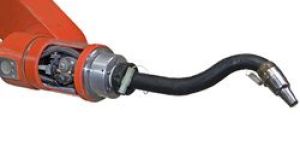
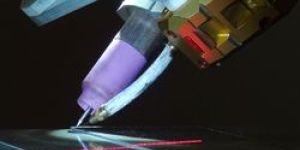
    A broad palette of torches is available for every welding or cutting application with igm robots - ranging from straight torches or curved standard models to the 85° curved type, also available as special types on request.  All models feature an extremely stable design and (for MIG/MAG welding) integrated water cooling for torch body and nozzle. Torches are mounted at the robot's wrist flange through quick coupling and may be loaded with up to 900A with the tandem process.
    ...more
  • Welding Torch

    Welding Torch

    Request for Price

    A broad palette of torches is available for every welding or cutting application with igm robots - ranging from straight torches or curved standard models to the 85° curved type, also available as special types on request.  All models feature an extremely stable design and (for MIG/MAG welding) integrated water cooling for torch body and nozzle. Torches are mounted at the robot's wrist flange through quick coupling and may be loaded with up to 900A with the tandem process.

    ...more
    Get Best Price
  • V Seams

    V Seams

    Get Latest Price

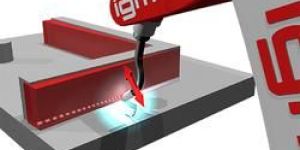
    During the welding process arc seam sensing is used to compensate for positional tolerances of the welding seam. Perfect control of welding By means of a special software and specifically designed hardware, the "actual" seam position of fillets and V-shaped joints is computed by processing data measured while arc weaving, giving a corresponding shifting of the original programmed point/s to the true seam position. This arc seam sensing technique can be used with a complete range of welding transfers such as short arc, spray arc and pulsed arc welding - using single or Tandem applications. By processing data regarding the welding current variation, the robot control system is able to determine the exact welding joint position in 3D during the oscillating welding process. Originally programmed paths are corrected accordingly. The programmed path is corrected on-line in such a way, that the robot follows the joint in all 3 dimensions and keeps the stick out constant throughout the entire welding seam. Function principle of the arc seam tracking sensor This online welding seam tracking process is realised by the patented and proven arc controlled seam tracking sensor, type AST. A built in welding current measuring system via a shunt resistor is permanently measuring the welding arc. The AST sensor card is evaluating the measurement and recording the values at each oscillating point and the middle point. The measurements of the first few oscillating points are recorded and then kept constant throughout the welding joint. Correction possibilities for the arc seam tracking sensor Generally several parameters of the used supplies for the robot installation (welding gas purity, welding wire quality, work piece material, different welding parameters, etc.) have an influence on the welding results.In order to compensate these variations which result in a different arc type, the arc seam tracking sensor AST can be programmed with the following online adjustable settings: Sensor sensitivity in width (1-10) Sensor sensitivity in height (1-10) Distance of deviations at multilayer Arc seam tracking for multilayer welding The deviations of the weld groove position ascertained during welding of the root pass will be taken into account for all cover passes. The specific software enables not only to record the deviations with respect to the positions of the programmed steps.When generating the program, it is also possible to determine the number of intermediate points where off-sets should be memorised and subsequently taken into consideration for welding of the cover passes. By one single step only, it will then be possible to program also long seams which have important deviations in the course of the groove.Certainly the RCE software enables the programmer to jump between welds to balance the heat input.  
    ...more
  • V Seams

    V Seams

    Request for Price

    During the welding process arc seam sensing is used to compensate for positional tolerances of the welding seam. Perfect control of welding By means of a special software and specifically designed hardware, the "actual" seam position of fillets and V-shaped joints is computed by processing data measured while arc weaving, giving a corresponding shifting of the original programmed point/s to the true seam position. This arc seam sensing technique can be used with a complete range of welding transfers such as short arc, spray arc and pulsed arc welding - using single or Tandem applications. By processing data regarding the welding current variation, the robot control system is able to determine the exact welding joint position in 3D during the oscillating welding process. Originally programmed paths are corrected accordingly. The programmed path is corrected on-line in such a way, that the robot follows the joint in all 3 dimensions and keeps the stick out constant throughout the entire welding seam. Function principle of the arc seam tracking sensor This online welding seam tracking process is realised by the patented and proven arc controlled seam tracking sensor, type AST. A built in welding current measuring system via a shunt resistor is permanently measuring the welding arc. The AST sensor card is evaluating the measurement and recording the values at each oscillating point and the middle point. The measurements of the first few oscillating points are recorded and then kept constant throughout the welding joint. Correction possibilities for the arc seam tracking sensor Generally several parameters of the used supplies for the robot installation (welding gas purity, welding wire quality, work piece material, different welding parameters, etc.) have an influence on the welding results.In order to compensate these variations which result in a different arc type, the arc seam tracking sensor AST can be programmed with the following online adjustable settings: Sensor sensitivity in width (1-10) Sensor sensitivity in height (1-10) Distance of deviations at multilayer Arc seam tracking for multilayer welding The deviations of the weld groove position ascertained during welding of the root pass will be taken into account for all cover passes. The specific software enables not only to record the deviations with respect to the positions of the programmed steps.When generating the program, it is also possible to determine the number of intermediate points where off-sets should be memorised and subsequently taken into consideration for welding of the cover passes. By one single step only, it will then be possible to program also long seams which have important deviations in the course of the groove.Certainly the RCE software enables the programmer to jump between welds to balance the heat input.  

    ...more
    Get Best Price
  • Torch Exchange System

    Torch Exchange System

    Get Latest Price

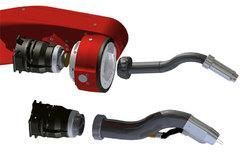
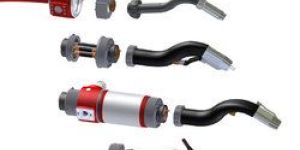
    Single wire and tandem processes may be used with a robot by exchanging the welding torch. The exchange process includes threading the torch through the hollow shaft and tightening it by a rotary motion. The hose packets always stay connected with the torches during the exchange processes. All welding media may be centrally passed through the hollow shaft. This design continues to support a significant advantage of the igm concept: No passing of hose packets outside of the robot's wrist axis for maintaining full torch movement. Automatic torch exchange system The igm welding robots can be equipped with an automatic torch exchange system, integrated into the hollow shaft of the wrist joint axis. Due to the hollow shaft in the wrist joint, the various torches (with hose packages coupled) can be fed through. Fixing is assured by a rotation movement.  This unique arrangement offers the following advantages: All media are lead through the robots wrist joint Torch can rotate almost 720° Flexibility of robot arm remain Extreme slim design Combination single wire - TIME TWIN possible Short changing time - approx. 10 s only
    ...more
  • Torch Exchange System

    Torch Exchange System

    Request for Price

    Single wire and tandem processes may be used with a robot by exchanging the welding torch. The exchange process includes threading the torch through the hollow shaft and tightening it by a rotary motion. The hose packets always stay connected with the torches during the exchange processes. All welding media may be centrally passed through the hollow shaft. This design continues to support a significant advantage of the igm concept: No passing of hose packets outside of the robot's wrist axis for maintaining full torch movement. Automatic torch exchange system The igm welding robots can be equipped with an automatic torch exchange system, integrated into the hollow shaft of the wrist joint axis. Due to the hollow shaft in the wrist joint, the various torches (with hose packages coupled) can be fed through. Fixing is assured by a rotation movement.  This unique arrangement offers the following advantages: All media are lead through the robots wrist joint Torch can rotate almost 720° Flexibility of robot arm remain Extreme slim design Combination single wire - TIME TWIN possible Short changing time - approx. 10 s only

    ...more
    Get Best Price
  • Torch Drive

    Torch Drive

    Get Latest Price

    The extremely compact feed mechanism guarantees reliable wire supply including thin and soft additional welding materials. Media feed through hollow shaft Precision The special design with two or four driven rolls allows for integrating the feed in the robot's front axis with single wire and tandem processes. The media feed through the hollow shaft, particularly advantageous for welding applications by allowing almost 720° torch rotation, is also supported for this type. The built-in, sealed cover reliably protects the feeding unit from contamination during the welding process.  
    ...more
  • Torch Drive

    Torch Drive

    Request for Price

    The extremely compact feed mechanism guarantees reliable wire supply including thin and soft additional welding materials. Media feed through hollow shaft Precision The special design with two or four driven rolls allows for integrating the feed in the robot's front axis with single wire and tandem processes. The media feed through the hollow shaft, particularly advantageous for welding applications by allowing almost 720° torch rotation, is also supported for this type. The built-in, sealed cover reliably protects the feeding unit from contamination during the welding process.  

    ...more
    Get Best Price
  • Teach Pendant

    Teach Pendant

    Get Latest Price

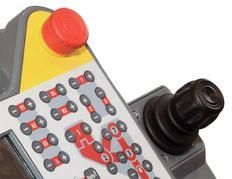
    All robot functions may be controlled by the outstanding teach pendant K6 without an additional keyboard. The resistant plastic housing makes for an extremely light weight of 1.3 kg; The lightweight teach pendant includes a 8.4” touch screen, an USB plug on the back is provided for memory sticks. The pushbuttons may be easily used and operated even when wearing protective gloves; the pushbuttons as well as the optional joystick are designed for heavy use. igm robot console The teach pendant may be used by right and left handed persons and may also be operated in awkward positions. Following operating languages are currently available by default and can be changed anytime at runtime: English, German, French, Spanish, Italian, Swedish, Dutch, Finnish, Czech, Hungarian, Chinese, Russian, Korean, Turkish, Polish As a key element of the RCE control system, the unique teach pendant K6 assembles all the control functions of the RCE control system. No additional keyboard is necessary. The industrial design award winning lightweight teach pendant is made out of a high resistant plastic mould and a keyboard panel at topside with an embedded LCD touch screen. The sensible buttons are palpable to enable the operator to touch and feel each button even with working gloves on, compared to a touch screen display. The revolutionary and widely favoured shape of the teach pendant allows a right hand and left operationas well as many other holding positions. A clear and simple display of each axis button allows the operator a distinctive movement of each axis without pushing the wrong axis button my mistake. A courser block offers easy navigation in the RCe software menus and replaces any necessary mouse. Joystick for teach pendant K6, type K6-JOY This heavy-duty joystick can be optionally mounted directly to the teach pendant K6 and allows to move the robot in a quick and simple way. There are available 3 modes for the joystick selectable by push-buttons on the teach pendant: Robot movement in world mode Robot orientation change in world mode Tracks movement with robot TCP keep in position All 3 channels of the joystick are speed sensitive. This means, moving the joystick slightly, the robot will move slowly. Moving the joystick more, the robot moves faster Software for RCE controller, type K6 igm programming method The RCE software is designed specifically for arc welding, allowing an extremely specialized control of the welding process, while at the same time our software engineers strive for ease of use. igm takes great pride in the fact that our robotic welding systems are quite possibly the most "User-Friendly" in the industry. igm robot programming software has been specially developed for the application arc welding. All implemented functions aim to facilitate the programming task and to accomplish the needs of the robot programmer forextreme quick and comfortable step program generation. The welding seam parameters (such as voltage, ampere, welding speed, oscillating data, end crater) may either be programmed manually at each welding step of a work piece program, or defined in a separate welding data library. Any work piece program can call up these welding seam definitions from this welding data library. To safe time in programming, any work piece program also can call up any kind of auxiliary program as a subroutine. Tree-menu concept of RCE software The RCE robot software is based on a tree-menu concept, which means that all the step program menu points are all included on only one page, but menu points may be compressed or decompressed to hide or display the submenus as required. Different background colours and "softkey buttons" for the adapted menu features makes the operating and programming very easy. Some screenshots of the RCE software below shall illustrate some examples how easy and convenient programming and operating is. Diagnosis features of the RCE control system As all the software commands, messages and help text is all clearly written in text messages, also the error and status messages are written in a text message. The message history can be easily saved on a USB stick along with a complete status of the entire RCE control system for a detailed diagnosis by igm engineers. All the service features are available in the service menu and easy to understand due to the simplicity of the text messages. Software features for teach-in programming Welding Data Library This feature enables the robot programmer to establish individual and re-usable welding seam definitions, stored in a separate welding parameter library. Each welding seam definition can contain travel speed, torch angle, wire feed speed, arc voltage, oscillation frequency and pattern, seam tracking parameters, end crater fill parameters for both single and multiple pass welds and other parameters. Once the weld seam definition is established it can be recalled and used where required in the part program. Multilayer Welding This feature provides maximum flexibility when multiple pass welding is required. The programmer can off-set the weld torch for each weld pass by jogging the robot to the desired location, cover pass in reverse direction and apply start and end deviations along the weld path. The torch angle and weld parameters can be changed for each cover pass. Different crater fill routines can also be added for each of the weld passes. End Crater Filling In addition to the weld parameters, the robot can be programmed to back-up a distance. The software also enables the weld parameters to be sloped over the distance and time programmed for. Welding Start Ignition Using this feature, the programmer can choose any combination of the following methods, to ensure ignition reliability at the start of a weld: Ignition Retry     - repeated ignition attempts Move&Init - at the beginning of the seam or during movement Special welding parameters for the ignition phase Creeping Start - reduced initial speed Rewind - program restart, by repeating the last two steps Mirroring of step programs A freely definable range of steps or complete program can be mirrored over a selectable axis. Minimum two points must be taught for the definition of the mirrored plane. Workstation Shift A Workstation Shift (Station-Shift) is required to "transfer" a robot program from one workstation to another work station. It may be performed either by any X, Y, or Z track or also rotational peripheral axes. The work station shift may be combined with a mirror function. Program Jumps This feature enables conditions to be checked within a program. In the case certain conditions are not met the robot can be programmed to jump automatically to another part of the program or set an alarm (to warn of a certain condition). Typically digital I/O settings will activate or deactivate this feature. Program Stop Recovery In the case of a program stop (or the robot stops itself due to a process problem), such as the need to replace the contact tip, the robot will automatically create an temporarily interrupt step. Then the operator can move the robot away manually. By pressing a single button on the teach pendant, the robot will return to the interrupt step immediately. Digital I/O Function Functions are used to arbitrarily set or reset digital 24 Volt outputs or to check and monitor digital 24 Volt inputs. Within a function, outputs may be set and - simultaneously - individual inputs may be checked. Sensor Program Shifting The sensor program shifting feature works in 1D, 2D and 3D with the following sensors: GNS, TSP, TAF and ELS. Arc Seam Tracking Sensor The arc seams tacking sensor AST is tracking the welding seam position during welding in 3D. Online Welding Seam Tracking This sensor enables to track and measure the welding seam during the welding process and is utilised by sensor type: iCAM  
    ...more
  • Teach Pendant

    Teach Pendant

    Request for Price

    All robot functions may be controlled by the outstanding teach pendant K6 without an additional keyboard. The resistant plastic housing makes for an extremely light weight of 1.3 kg; The lightweight teach pendant includes a 8.4” touch screen, an USB plug on the back is provided for memory sticks. The pushbuttons may be easily used and operated even when wearing protective gloves; the pushbuttons as well as the optional joystick are designed for heavy use. igm robot console The teach pendant may be used by right and left handed persons and may also be operated in awkward positions. Following operating languages are currently available by default and can be changed anytime at runtime: English, German, French, Spanish, Italian, Swedish, Dutch, Finnish, Czech, Hungarian, Chinese, Russian, Korean, Turkish, Polish As a key element of the RCE control system, the unique teach pendant K6 assembles all the control functions of the RCE control system. No additional keyboard is necessary. The industrial design award winning lightweight teach pendant is made out of a high resistant plastic mould and a keyboard panel at topside with an embedded LCD touch screen. The sensible buttons are palpable to enable the operator to touch and feel each button even with working gloves on, compared to a touch screen display. The revolutionary and widely favoured shape of the teach pendant allows a right hand and left operationas well as many other holding positions. A clear and simple display of each axis button allows the operator a distinctive movement of each axis without pushing the wrong axis button my mistake. A courser block offers easy navigation in the RCe software menus and replaces any necessary mouse. Joystick for teach pendant K6, type K6-JOY This heavy-duty joystick can be optionally mounted directly to the teach pendant K6 and allows to move the robot in a quick and simple way. There are available 3 modes for the joystick selectable by push-buttons on the teach pendant: Robot movement in world mode Robot orientation change in world mode Tracks movement with robot TCP keep in position All 3 channels of the joystick are speed sensitive. This means, moving the joystick slightly, the robot will move slowly. Moving the joystick more, the robot moves faster Software for RCE controller, type K6 igm programming method The RCE software is designed specifically for arc welding, allowing an extremely specialized control of the welding process, while at the same time our software engineers strive for ease of use. igm takes great pride in the fact that our robotic welding systems are quite possibly the most "User-Friendly" in the industry. igm robot programming software has been specially developed for the application arc welding. All implemented functions aim to facilitate the programming task and to accomplish the needs of the robot programmer forextreme quick and comfortable step program generation. The welding seam parameters (such as voltage, ampere, welding speed, oscillating data, end crater) may either be programmed manually at each welding step of a work piece program, or defined in a separate welding data library. Any work piece program can call up these welding seam definitions from this welding data library. To safe time in programming, any work piece program also can call up any kind of auxiliary program as a subroutine. Tree-menu concept of RCE software The RCE robot software is based on a tree-menu concept, which means that all the step program menu points are all included on only one page, but menu points may be compressed or decompressed to hide or display the submenus as required. Different background colours and "softkey buttons" for the adapted menu features makes the operating and programming very easy. Some screenshots of the RCE software below shall illustrate some examples how easy and convenient programming and operating is. Diagnosis features of the RCE control system As all the software commands, messages and help text is all clearly written in text messages, also the error and status messages are written in a text message. The message history can be easily saved on a USB stick along with a complete status of the entire RCE control system for a detailed diagnosis by igm engineers. All the service features are available in the service menu and easy to understand due to the simplicity of the text messages. Software features for teach-in programming Welding Data Library This feature enables the robot programmer to establish individual and re-usable welding seam definitions, stored in a separate welding parameter library. Each welding seam definition can contain travel speed, torch angle, wire feed speed, arc voltage, oscillation frequency and pattern, seam tracking parameters, end crater fill parameters for both single and multiple pass welds and other parameters. Once the weld seam definition is established it can be recalled and used where required in the part program. Multilayer Welding This feature provides maximum flexibility when multiple pass welding is required. The programmer can off-set the weld torch for each weld pass by jogging the robot to the desired location, cover pass in reverse direction and apply start and end deviations along the weld path. The torch angle and weld parameters can be changed for each cover pass. Different crater fill routines can also be added for each of the weld passes. End Crater Filling In addition to the weld parameters, the robot can be programmed to back-up a distance. The software also enables the weld parameters to be sloped over the distance and time programmed for. Welding Start Ignition Using this feature, the programmer can choose any combination of the following methods, to ensure ignition reliability at the start of a weld: Ignition Retry     - repeated ignition attempts Move&Init - at the beginning of the seam or during movement Special welding parameters for the ignition phase Creeping Start - reduced initial speed Rewind - program restart, by repeating the last two steps Mirroring of step programs A freely definable range of steps or complete program can be mirrored over a selectable axis. Minimum two points must be taught for the definition of the mirrored plane. Workstation Shift A Workstation Shift (Station-Shift) is required to "transfer" a robot program from one workstation to another work station. It may be performed either by any X, Y, or Z track or also rotational peripheral axes. The work station shift may be combined with a mirror function. Program Jumps This feature enables conditions to be checked within a program. In the case certain conditions are not met the robot can be programmed to jump automatically to another part of the program or set an alarm (to warn of a certain condition). Typically digital I/O settings will activate or deactivate this feature. Program Stop Recovery In the case of a program stop (or the robot stops itself due to a process problem), such as the need to replace the contact tip, the robot will automatically create an temporarily interrupt step. Then the operator can move the robot away manually. By pressing a single button on the teach pendant, the robot will return to the interrupt step immediately. Digital I/O Function Functions are used to arbitrarily set or reset digital 24 Volt outputs or to check and monitor digital 24 Volt inputs. Within a function, outputs may be set and - simultaneously - individual inputs may be checked. Sensor Program Shifting The sensor program shifting feature works in 1D, 2D and 3D with the following sensors: GNS, TSP, TAF and ELS. Arc Seam Tracking Sensor The arc seams tacking sensor AST is tracking the welding seam position during welding in 3D. Online Welding Seam Tracking This sensor enables to track and measure the welding seam during the welding process and is utilised by sensor type: iCAM  

    ...more
    Get Best Price
  • Robots

    Robots

    Get Latest Price

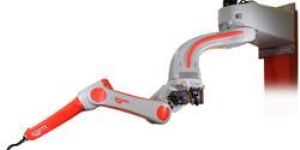
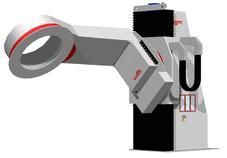
    The working radii of igm welding robots are between 1500 mm and 1900 mm, depending on type. This is the length of the swivel arms (550 mm or 750 mm each) plus the usual eccentricity of the first main axis, 400 mm. Extending this by lengthening the arm isn't always effective, since both reach and accessibility are essential when welding complex work pieces.   The ability to plunge inside the component is therefore a significant criterion. Long robot arms obstruct such movements since they make large compensatory movements over external travel axes necessary. Improved movement is always achieved when more axes are used. The priorities are accessibility, reach-over of components, the joining crashing and overlapping of working ranges by multiple robots in one system. Additional priorities include the prevention of compensatory travel over floor track systems, i.e. shorter floor track systems. This also results in significant space savings, smaller footprint and thus lower investment costs. Since the rotating base can swivel ± 180°, any number of positions within working range can be approached from different directions. When using 2 robots on one station, the additional axes enable the dangers of collision to be more easily prevented. This means that both robots can weld seams which are in close proximity, or even that their working ranges overlap. For example, one of the robots is able to weld the inside of a U-shaped component, whilst the other is welding the outside.     Features Significant features of the RTE 499: Diameter of area of movement: 5,200 mm Curved rotating base to reach around interfering contours of the workpiece All media (power, water, wire, sensor cables control cables) are passed through the rotating base Swivel range ± 180° Fully integrated in the control system as 7th axis  
    ...more
  • Robots

    Robots

    Request for Price

    The working radii of igm welding robots are between 1500 mm and 1900 mm, depending on type. This is the length of the swivel arms (550 mm or 750 mm each) plus the usual eccentricity of the first main axis, 400 mm. Extending this by lengthening the arm isn't always effective, since both reach and accessibility are essential when welding complex work pieces.   The ability to plunge inside the component is therefore a significant criterion. Long robot arms obstruct such movements since they make large compensatory movements over external travel axes necessary. Improved movement is always achieved when more axes are used. The priorities are accessibility, reach-over of components, the joining crashing and overlapping of working ranges by multiple robots in one system. Additional priorities include the prevention of compensatory travel over floor track systems, i.e. shorter floor track systems. This also results in significant space savings, smaller footprint and thus lower investment costs. Since the rotating base can swivel ± 180°, any number of positions within working range can be approached from different directions. When using 2 robots on one station, the additional axes enable the dangers of collision to be more easily prevented. This means that both robots can weld seams which are in close proximity, or even that their working ranges overlap. For example, one of the robots is able to weld the inside of a U-shaped component, whilst the other is welding the outside.     Features Significant features of the RTE 499: Diameter of area of movement: 5,200 mm Curved rotating base to reach around interfering contours of the workpiece All media (power, water, wire, sensor cables control cables) are passed through the rotating base Swivel range ± 180° Fully integrated in the control system as 7th axis  

    ...more
    Get Best Price
  • Robot System Periphery

    Robot System Periphery

    Get Latest Price

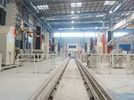
    The basic device is mounted on the robot periphery in an upright or suspended position. The external axes of the track systems are fully integrated in the control system as NC axes, significantly extending the working area of the robot.  A variety of different rotating and linear units are available, either as single axes or combined with up to three positioning units. It is also possible that several robots share a track axis. The positioning range of a longitudinal axis is up to 100m. 
    ...more
  • Robot System Periphery

    Robot System Periphery

    Request for Price

    The basic device is mounted on the robot periphery in an upright or suspended position. The external axes of the track systems are fully integrated in the control system as NC axes, significantly extending the working area of the robot.  A variety of different rotating and linear units are available, either as single axes or combined with up to three positioning units. It is also possible that several robots share a track axis. The positioning range of a longitudinal axis is up to 100m. 

    ...more
    Get Best Price
  • RCE Control System

    RCE Control System

    Get Latest Price

    The RCE control system is based on a standard PC with current processor technology. The complete control system for the six robot axes and up to ten external NC axes is included in a compact control cabinet connected to the robot, the teach pendant, the operating cassette, the external axes, and the power source by cables, pluggable on both sides. The RCE system includes fully digital servos controlled through EtherCAT. Concept of RCE control system The control system is a fully digital controlled system. This means there are only digital signal processors (DSP) involved in the entire control system and not any analogue electronic component. All the components of the control system, such as control cabinet, welding power source, each axis and the teach pendant are linked by a digital bus system.   A full digital robot control system brings the following advantages: No influence by any environmental disturbance like inductive fields of welding cables Quickest response time by fastest bus connection > smooth motion of robot Absolute reproducibility of welding result > highest consistency in welding quality Easy diagnosis possibilities of the entire robot control system > less skills and no special instruments for diagnosis are necessary By using modular drive technology and standard PC components a high reliability is guaranteed and the ability to remain constantly at the cutting edge of technology. Standard scope of supply of the control system RCE: Control cabinet RCE Teach pendant K6 Operating panel BK UPS battery buffer system Robot welding software RCE
    ...more
  • RCE Control System

    RCE Control System

    Request for Price

    The RCE control system is based on a standard PC with current processor technology. The complete control system for the six robot axes and up to ten external NC axes is included in a compact control cabinet connected to the robot, the teach pendant, the operating cassette, the external axes, and the power source by cables, pluggable on both sides. The RCE system includes fully digital servos controlled through EtherCAT. Concept of RCE control system The control system is a fully digital controlled system. This means there are only digital signal processors (DSP) involved in the entire control system and not any analogue electronic component. All the components of the control system, such as control cabinet, welding power source, each axis and the teach pendant are linked by a digital bus system.   A full digital robot control system brings the following advantages: No influence by any environmental disturbance like inductive fields of welding cables Quickest response time by fastest bus connection > smooth motion of robot Absolute reproducibility of welding result > highest consistency in welding quality Easy diagnosis possibilities of the entire robot control system > less skills and no special instruments for diagnosis are necessary By using modular drive technology and standard PC components a high reliability is guaranteed and the ability to remain constantly at the cutting edge of technology. Standard scope of supply of the control system RCE: Control cabinet RCE Teach pendant K6 Operating panel BK UPS battery buffer system Robot welding software RCE

    ...more
    Get Best Price
  • Portal Systems

    Portal Systems

    Get Latest Price

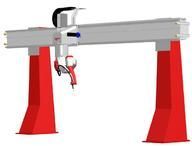
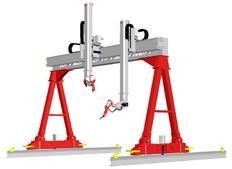
    igm offers portal gantry systems for welding large-scale components, customized for individual applications. Portal gantry systems range from a track gage of 3 to 25m with vertical tracks of up to 6m positioning range. One or two robots may be mounted on a portal; since the portal axis is controlled by the robot control system, it may also be used for positioning during execution of a welding step. The standard portal design includes a double-sided rack drive with AC servo motors, stable wheel house with integrated edge guide control on massive rails, moving control cabinet, power source, and a control console, if requested.
    ...more
  • Portal Systems

    Portal Systems

    Request for Price

    igm offers portal gantry systems for welding large-scale components, customized for individual applications. Portal gantry systems range from a track gage of 3 to 25m with vertical tracks of up to 6m positioning range. One or two robots may be mounted on a portal; since the portal axis is controlled by the robot control system, it may also be used for positioning during execution of a welding step. The standard portal design includes a double-sided rack drive with AC servo motors, stable wheel house with integrated edge guide control on massive rails, moving control cabinet, power source, and a control console, if requested.

    ...more
    Get Best Price
  • Laser Camera

    Laser Camera

    Get Latest Price

    Extremely effective, compact laser cameras are used, designed for tracking different welding seam types, for identifying and measuring detected gaps, and for compensating volumes. Synchronized laser scan technology The camera is based on synchronized laser scan technology, featuring high speed stability, large and programmable workspace, deep visual range, and robustness regarding ambient light and reflections.Impassivity against high frequencies and magnetic fields makes it an ideal device for many industrial processes under rough conditions. The igm laser camera iCAM is mounted on the wrist axis of the robot. It measures the position and volume of the weld groove online and adjusts the robot movement and the welding parameters accordingly. For the purpose of welding in narrow workpiece ranges, the camera can be automatically deposited and readopted during the welding program.This igm developed laser camera iCAM offers as an outstanding feature the complete integration into the robot control. Thus programming is done with the igm teach pendant K6 without the need for an additional PC. The user benefits from the wide range of languages, European as well as Asian ones, being supported by the robot software. By means of the logging function the whole joint geometry can be displayed, indicating gaps and volumes. A live view of the measuring field is given by grey scale value image. Optionally the camera can be mounted to a rotation device, integrated in the robot controller as sensoraxis.   Features of the laser camera, type iCAM extreme compact design - best accessibility for arc welding, optionally integration with sensoraxis user interface completely integrated in K6 control software, also in offline mode automatic control of exposure and laser power, adaptive sontrolled ROI (Region of Interest) Ethernet interface (100Mbit) and serial interface (RS422 galvanic separated) 6 predefined + 1 user joint types, 240 user definable profiles languages supported: English, German, Chinese, Swedish, French, Dutsch, Spanish, Italian, Czech, Hungarian, Finish, Russian, Korean
    ...more
  • Laser Camera

    Laser Camera

    Request for Price

    Extremely effective, compact laser cameras are used, designed for tracking different welding seam types, for identifying and measuring detected gaps, and for compensating volumes. Synchronized laser scan technology The camera is based on synchronized laser scan technology, featuring high speed stability, large and programmable workspace, deep visual range, and robustness regarding ambient light and reflections.Impassivity against high frequencies and magnetic fields makes it an ideal device for many industrial processes under rough conditions. The igm laser camera iCAM is mounted on the wrist axis of the robot. It measures the position and volume of the weld groove online and adjusts the robot movement and the welding parameters accordingly. For the purpose of welding in narrow workpiece ranges, the camera can be automatically deposited and readopted during the welding program.This igm developed laser camera iCAM offers as an outstanding feature the complete integration into the robot control. Thus programming is done with the igm teach pendant K6 without the need for an additional PC. The user benefits from the wide range of languages, European as well as Asian ones, being supported by the robot software. By means of the logging function the whole joint geometry can be displayed, indicating gaps and volumes. A live view of the measuring field is given by grey scale value image. Optionally the camera can be mounted to a rotation device, integrated in the robot controller as sensoraxis.   Features of the laser camera, type iCAM extreme compact design - best accessibility for arc welding, optionally integration with sensoraxis user interface completely integrated in K6 control software, also in offline mode automatic control of exposure and laser power, adaptive sontrolled ROI (Region of Interest) Ethernet interface (100Mbit) and serial interface (RS422 galvanic separated) 6 predefined + 1 user joint types, 240 user definable profiles languages supported: English, German, Chinese, Swedish, French, Dutsch, Spanish, Italian, Czech, Hungarian, Finish, Russian, Korean

    ...more
    Get Best Price
  • Gas Nozzles

    Gas Nozzles

    Get Latest Price

    This tactile sensor is used to determine the workpiece position or its components and individual parts by gaging the surface of the workpiece. In each case, the successional part of the program is shifted according to determined deviations.  igm - robots with sensor shift Sensor shifting may be applied for correction of an arbitrary amount of individual points, entire sections of a welding program or entire programs. Combination with arc seam sensing is feasible. The control system supports shifting, rotating, and tilting of a program, depending on position change. Function principle of the gas nozzle sensor A control voltage is applied on to the gas nozzle and then a various number of searching runs are performed. As soon as the gas nozzle comes into contact with the work piece, it is discharged and the robot stops immediately. This discharge is recorded on-line by the respective sensor board in the control cabinet and subsequently the robot moves to the next searching run. After having completed the search runs, the robot controller is shifting the respective program part accordingly. Sensor program shifts may also be nested, that means, additional search sequences and blocks to be shifted may be programmed within an other block to be shifted. The sensor shifting feature can be used to correct any number of single points, complete sections of the welding program, or complete programs. Different possibilities of program shift By a system-specific control algorithm, tolerances of the work piece (determined during the first search runs) are taken into account by immediately shifting the next search path. The sensor is therefore perfectly suitedalso for small work piece components which have extreme tolerances. Due to the particular structure of the software, only the number of search runs definitely required for the exact definition of the position, is to be programmed. This means, if a part can be shifted in one direction only, one single search run on one reference point will be sufficient. To shift a program in parallel to the space co-ordinates, 3 search runs will be necessary. The program can be shifted, turned and tilted in accordance with the position deviations of 3 reference points, ascertained by 6 search runs only.
    ...more
  • Gas Nozzles

    Gas Nozzles

    Request for Price

    This tactile sensor is used to determine the workpiece position or its components and individual parts by gaging the surface of the workpiece. In each case, the successional part of the program is shifted according to determined deviations.  igm - robots with sensor shift Sensor shifting may be applied for correction of an arbitrary amount of individual points, entire sections of a welding program or entire programs. Combination with arc seam sensing is feasible. The control system supports shifting, rotating, and tilting of a program, depending on position change. Function principle of the gas nozzle sensor A control voltage is applied on to the gas nozzle and then a various number of searching runs are performed. As soon as the gas nozzle comes into contact with the work piece, it is discharged and the robot stops immediately. This discharge is recorded on-line by the respective sensor board in the control cabinet and subsequently the robot moves to the next searching run. After having completed the search runs, the robot controller is shifting the respective program part accordingly. Sensor program shifts may also be nested, that means, additional search sequences and blocks to be shifted may be programmed within an other block to be shifted. The sensor shifting feature can be used to correct any number of single points, complete sections of the welding program, or complete programs. Different possibilities of program shift By a system-specific control algorithm, tolerances of the work piece (determined during the first search runs) are taken into account by immediately shifting the next search path. The sensor is therefore perfectly suitedalso for small work piece components which have extreme tolerances. Due to the particular structure of the software, only the number of search runs definitely required for the exact definition of the position, is to be programmed. This means, if a part can be shifted in one direction only, one single search run on one reference point will be sufficient. To shift a program in parallel to the space co-ordinates, 3 search runs will be necessary. The program can be shifted, turned and tilted in accordance with the position deviations of 3 reference points, ascertained by 6 search runs only.

    ...more
    Get Best Price
  • Flexible Manufacturing System

    Flexible Manufacturing System

    Get Latest Price

    For special applications, igm produces customized constructions for your individual needs. The applications are for example gas bottles machines, straight line machines or complete production lines. In these flexible systems more than just the welding technology is required: loading, conveying, stretching, bending, cutting, measuring, manipulating, editing, storing, unloading, controling. Complex manufacturing tasks require flexible solutions. igm has experiences over many years in engineering and realisation of full automatic manufacturing lines for various piece parts sub components. For additional production requirements we provide handling devices, we develop special purpose machines and take care of your whole project from order placing up to final commissioning as a main contractor. Basic concepts of flexible manufacturing lines: FMS for a single work piece type and a single robot cell FMS for several work piece types and a single robot cell FMS for a single work piece type and several robot cells FMS for several work piece types and several robot cells Components of manufacturing lines Loading- / unloading stations Roller conveyors Conveyor carriage Buffer stations Storage places Line control The whole fabrication line including the robot cells is controlled by one single host computer. Graphic information on the display makes operation and monitoring easy. Work pieces of totally different shapes and dimensions are handled by specially designed pallets. The innner side of these pallets is designed to clamp the piece parts while the vertical outer side represents the patente clamping device on the positioner's face plate. A built-in sensor monitors the correct clamping.The conveyor carriage with a satellite carriage and a scissor-table conveys the parts to the robot station, where they are clamped automatically. In each feeding-station the main conveyor is pneumatically indexed with the aim to assure a correct position in relation to the rails of the satellite carriage. 
    ...more
  • Flexible Manufacturing System

    Flexible Manufacturing System

    Request for Price

    For special applications, igm produces customized constructions for your individual needs. The applications are for example gas bottles machines, straight line machines or complete production lines. In these flexible systems more than just the welding technology is required: loading, conveying, stretching, bending, cutting, measuring, manipulating, editing, storing, unloading, controling. Complex manufacturing tasks require flexible solutions. igm has experiences over many years in engineering and realisation of full automatic manufacturing lines for various piece parts sub components. For additional production requirements we provide handling devices, we develop special purpose machines and take care of your whole project from order placing up to final commissioning as a main contractor. Basic concepts of flexible manufacturing lines: FMS for a single work piece type and a single robot cell FMS for several work piece types and a single robot cell FMS for a single work piece type and several robot cells FMS for several work piece types and several robot cells Components of manufacturing lines Loading- / unloading stations Roller conveyors Conveyor carriage Buffer stations Storage places Line control The whole fabrication line including the robot cells is controlled by one single host computer. Graphic information on the display makes operation and monitoring easy. Work pieces of totally different shapes and dimensions are handled by specially designed pallets. The innner side of these pallets is designed to clamp the piece parts while the vertical outer side represents the patente clamping device on the positioner's face plate. A built-in sensor monitors the correct clamping.The conveyor carriage with a satellite carriage and a scissor-table conveys the parts to the robot station, where they are clamped automatically. In each feeding-station the main conveyor is pneumatically indexed with the aim to assure a correct position in relation to the rails of the satellite carriage. 

    ...more
    Get Best Price

Be first to Rate

Rate This

Choose the service or product you're reviewing for this business

How would you rate the business?

What did you like and dislike?

  • Response
  • Delivery
  • Quality

Tell us about your experience?

About the Company

  • Primary Business Retailer
  • Secondary Business Type Manufacturer / Exporters / Wholesale Suppliers

Opening Hours

  • SUN : Closed
  • MON : 9:30 AM - 6:30 PM
  • TUE : 9:30 AM - 6:30 PM
  • WED : 9:30 AM - 6:30 PM
  • THU : 9:30 AM - 6:30 PM
  • FRI : 9:30 AM - 6:30 PM
  • SAT : 9:30 AM - 6:30 PM
igm Roboticsystems India Pvt. Ltd, a 100% foreign owned subsidary of igm Robotersysteme AG, Austria is pleased to announce, that we completed a further phase of expansion of our business operations in India by opening of our new establishment in Pune.
Along with our group companies POLYSOUDE from France, SST and PTR from Germany we are pleased to offer you the following services at our brand new 15,000 sqft facility.
LOCATION OF igm INDIA
Located in the MIDC at Pimpri-Chinchwad, igm India is close to Pune downtown, near to the Pune airport and just off the old Mumbai-Pune Highway (NH50).
Read More »

Contact Information

Igm Roboticsystems India Pvt. Ltd

  • Igm Roboticsystems India Pvt. Ltd
  • , X-17, MIDC Bhosari, , Pune, Maharashtra
top