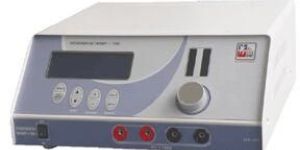
Interferential Therapy Unit Dealers in Ghaziabad

(3 products available)
  • Electrotherapy (IFT TENS) LCS

    Electrotherapy (IFT TENS) LCS

    Get Price Quote

    • Availability5 kg Approx
    • DIMENSION (L*H*D)358mm, 149mm, 354mm
    • OPERATING VOLTAGE220V AC 50Hz
    • ABSORPTION50 Watts
    • FUSES1 Amp
    • ROOM TEMPERATURE10° to 40° C.
    • MOISTURE10% to 40%
    • DisplayLCD large 20x4
    • Preset Program50
    • Customise User Program50
    • Max out-put Current100mA Digital Display CH1 & CH2
    • Carrier Frequency2 KHz & 4 KHz
    • Base AMF1-150 MHz
    • Spectrum01-150 MHz
    • Therapy Mode4 Pole Classic, 4 Pole Vector, 2 Pole Modulated
    • Time60 Min
    • Cable & Electrode TestAvailable
    • TENS ModeContinuous / Burst
    • TENS Output150 v Peak To Peak
    • TEST Frequency1 to 250 Hz stapes of 1 Hz
    • Burst Mode1, 2, 3, 4 & 5 Hz
    • LCS Combination Therapy (IFT+TENS) : Intreferential Electro-Therapy uses electrical pulses to stimulate nerves and muscles in the body, to help relieve pain.  
    ...more
  • Interferential Therapy Tens

    Interferential Therapy Tens

    20,000 / Piece

    • Availability1.2kg Approx.
    • Operating Voltage220V AC 50HZ
    • Dimension (L*H*D*)270mm, 85mm, 210mm
    • Absorption50 watts
    • Fuses1 Amp
    • Room Temperature10*C to 40*C
    • Moisture10% 40%
    • DisplayLCD 20×4
    • Preset Program25
    • Customize User Program25
    • Max output Current00mA Digital Display CH1 &CH2
    • Carrier Frequency2 KHz & 4KHz & Russian
    • Base AMF1-150 Hz
    • Spectrum01-150Hz
    • Therapy Mode4 Pole Classic, 4 Pole Vector, 2 Pole Modulated
    • Time99 Min.
    • TENS ModeContinuous / Burst
    • TENS Output150 v Peak To Peak
    • Tens Frequency1 to 250 Hz steps of 1 Hz
    • Burst1, 2, 3, 4, & 5 Hz
    • INTERFERENTIAL THERAPY + TENS Interferential Electro-Therapy uses electrical pulses to stimulate nerves and muscles in the body, to help relieve pain.
    ...more
  • Interferential Therapy

    Interferential Therapy

    Get Price Quote

    • Dimension (L*H*D)352mm, 125mm, 331mm
    • Weight)5 Kg Approx.
    • Operating Voltage110-270V 50Hz
    • Absorption46-Watts Max
    • Fuses1 Amp
    • Room Temperature10ºC to 40ºC
    • Moisture10% to 80%
    • Preset Programs50 program
    • Customize Program99 Create Programs
    • Probe TestCable & Electrode Test
    • Max. Output Current100mA Digital Display for CH-1 & CH-2
    • Max Output Voltage100V (Peak to Peak)
    • Medium Frequency2 KHz& 4 KHz
    • Base AMF0-250 Hz
    • Spectrum0-250 Hz
    • Therapy Mode4P, 4PV, 2P
    • Wave shapeTra, Tri, Rec.
    • Vector Mode2PL, 4PL, 4PT, 4PNL
    • Treatment Time01 to 99 Minutes adjustable
    • Patient SafetyAvailable
    • RUSSIAN CURRENTMedium Frequency
    • 2.5 KHzBase AMF
    • 0-200 HzSpectrum
    • 0-200 HzDIADYNAMIC CURRENT
    • Current ModeCP, LP, DF, MF
    • Low Frequency50Hz & 100Hz
    • The effects of tissue stimulation with these 'medium frequency' currents (medium frequency in electromedical terms is usually considered to be 1KHz-100KHz) has yet to be established. It is unlikely to do nothing at all, but in terms of current practice, little is known of its physiological effects. It is not capable of direct stimulation of nerve in the common context of such stimulation. Physiotherapy Interferential therapy utilizes two of these medium frequency currents, passed through the tissues simultaneously, where they are set up so that their paths cross & they literally interfere with each other. This interference gives rise to an interference (beat frequency) which has the characteristics of low frequency stimulation – in effect the interference mimics a low frequency stimulation. The exact frequency of the resultant beat frequency can be controlled by the input frequencies. If for example, one current was at 4000Hz and its companion current at 3900Hz, the resultant beat frequency would be at 100Hz, carried on a medium frequency 3950Hz amplitude modulated current. By careful manipulation of the input currents it is possible to achieve any beat frequency that you might wish to use clinically. Modern machines usually offer frequencies of 1-150Hz, though some offer a choice of up to 250Hz or more. To a greater extent, the therapist does not have to concern themselves with the input frequencies, but simply with the appropriate beat frequency which is selected directly from the machine.   ELECTRODES, CONTACT AND SAFETY Virtually all interferential clinical units are supplied with carbon rubber electrodes. The clinician should be aware that either water soaked sponges or a conducting gel should always be used between the electrode and the tissue. This will insure a uniform contact and provide for even disbursement of the current over the entire surface area of the electrode. If water only is used as a conductive agent, pooling may occur with resulting dry spots under the electrode. The current will then become intensified at the site of best conduction, the water pools, with little or no current flow elsewhere. With "true interferential therapy device" units this could result in over stimulation of tissue under the water pools and even possible tissue burns as depolarized tissue will not be able to sense the over stimulation. While some ift interferential still offer the vacuum electrode system, many clinicians have discontinued their use. Extra maintenance, tissue bruising and uneven current flow have been cited as reasons for a reduction in the popularity of vacuum systems. Self adhesive electrodes are rapidly becoming the favorite of clinicians due to the ease of use, patient acceptance and elimination of possible cross-contamination. Difficult to apply areas such as shoulders, hips and the cervical spine are easily treated with the self-adhesive electrodes. Also, recent improvements in adhesive agents have made longer use possible and prices have been reduced substantially. If carbon rubber electrodes are used, care should be taken to insure proper current flow. When conductive gels are used, the gel will create a glaze over the surface of the electrodes with long-term use. The glaze may prevent the flow of current over the entire electrode surface. Cleaning the electrode periodically with a mild soap and water and soft brush is recommended. It is not a good practice to use conducting mist sprays in lieu of other conducting agents. This is due to the saline content of the sprays which has been shown to destroy the carbon content of the electrode, thus rendering the electrode useless. The best selection for this device is re-usable Silver Connector Electrodes.   Intensity oF Current Interferential therapy unit provides a comfortable, soothing stimulation and should never be strong enough to cause any discomfort to the patient. Higher intensities should not be considered "better" as far as obtaining results. It is important to note that once the patients comfort level is established at the onset of therapy, the intensity should not be increased during the treatment.
    ...more
top