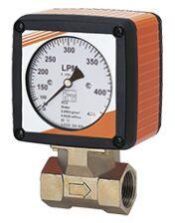
The KOBOLD flow meter model RCD is used for measuring and monitoring liquid and gas flows. The device works on the well-known principle of the Venturi nozzle. A small pressure difference proportional to the flow is produced by the flowing medium at an orifice constriction (nozzle) in the device housing. The shape of the nozzle is based on the flow, whereby the flow characteristic remains constant over the entire measuring range.
The KOBOLD flow meter model RCD is used for measuring and monitoring liquid and gas flows. The device works on the well-known principle of the Venturi nozzle. A small pressure difference proportional to the flow is produced by the flowing medium at an orifice constriction (nozzle) in the device housing. The shape of the nozzle is based on the flow, whereby the flow characteristic remains constant over the entire measuring range.
Temperature: 0 ... +200°C, Humidity: 0 ... 100% rH, pmax: 25 bar, tmax: +200°C
Output: 2x 4 - 20 mA, Temperature: ±0,1°C
Humidity: ±2 % rH.The range AFK-G humiditytemperature sensors are sensors for measuring relative humidity and temperature (optional) in air and other non-aggressive gases for an operating temperature to 200 °C. The high pressure variant can be used up to a pressure of 25 bar. The sensors are thus ideally suited for measuring humidity in industrial processes. The sensors are based on capacitive metrology which is reasonably-priced, maintenance-free and highly accurate.
The change in capacitance is converted to an electrical output signal by electronics normally mounted on the humidity sensor element. Both parts form a capacitive humidity sensor that can be adjusted using humidity references. Accuracy is approximately ± 2% rH. The transmitters offer a 4 - 20 mA analogue output for relative humidity and a second 4 - 20 mA output for temperature when specified.
Temperature: 0 ... +200°C, Humidity: 0 ... 100% rH, pmax: 25 bar, tmax: +200°C
Output: 2x 4 - 20 mA, Temperature: ±0,1°C
Humidity: ±2 % rH.The range AFK-G humiditytemperature sensors are sensors for measuring relative humidity and temperature (optional) in air and other non-aggressive gases for an operating temperature to 200 °C. The high pressure variant can be used up to a pressure of 25 bar. The sensors are thus ideally suited for measuring humidity in industrial processes. The sensors are based on capacitive metrology which is reasonably-priced, maintenance-free and highly accurate.
The change in capacitance is converted to an electrical output signal by electronics normally mounted on the humidity sensor element. Both parts form a capacitive humidity sensor that can be adjusted using humidity references. Accuracy is approximately ± 2% rH. The transmitters offer a 4 - 20 mA analogue output for relative humidity and a second 4 - 20 mA output for temperature when specified.
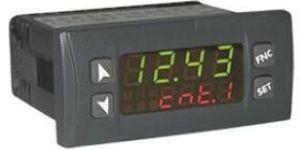
The compact small counter DAG-Z2F80W2 can be set in two different modes: Single or Double counter, all with independent setting. 3 universal digital inputs are available (NPNPNPTTL) can be used for bi-directional encoders reading, UPDOWN counter function, LOCKHOLD to lock or hold current visualization.
One input is also analogue in order to allow setpoint modification by an external potentiometer. Due to the two different modes and the scaling features, the counter is usable for a lot of different applications. In addition to an excellent cost effectiveness and high quality, the counter offers a rugged, compact housing and a brilliant display.
The compact small counter DAG-Z2F80W2 can be set in two different modes: Single or Double counter, all with independent setting. 3 universal digital inputs are available (NPNPNPTTL) can be used for bi-directional encoders reading, UPDOWN counter function, LOCKHOLD to lock or hold current visualization.
One input is also analogue in order to allow setpoint modification by an external potentiometer. Due to the two different modes and the scaling features, the counter is usable for a lot of different applications. In addition to an excellent cost effectiveness and high quality, the counter offers a rugged, compact housing and a brilliant display.
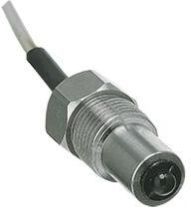
The optical level sensors of model OPT have been developed for monitoring transparent liquids. Due to the very small dimensions, very slight switching hysteresis and high repeatability, the instruments are also suited for service in small vessels. The optical sensor is situated in a robust housing.
The optical level sensors of model OPT have been developed for monitoring transparent liquids. Due to the very small dimensions, very slight switching hysteresis and high repeatability, the instruments are also suited for service in small vessels. The optical sensor is situated in a robust housing.
Magnetic level switches are used for the monitoring and control of liquid levels in vessels. Magnetic level switches are manufactured to customer specification. An overview of types available with minimum lengths of guide tube is set out on the following pages. Please refer to this overview when placing your order. Furthermore any limits can be specified within the limits found in the brochure. For example:
Magnetic level switches are used for the monitoring and control of liquid levels in vessels. Magnetic level switches are manufactured to customer specification. An overview of types available with minimum lengths of guide tube is set out on the following pages. Please refer to this overview when placing your order. Furthermore any limits can be specified within the limits found in the brochure. For example:
Material : brass, stainless steel, PVC-U, PP, PVDF, NBR
The fl ow indicator model UFJ for liquids and gases operates on the suspended fl oat principle; i.e. the installation position is vertical and the direction of fl ow is from bottom to top. The instrument consists of a measuring tube in which a section around the set value is cut out. It has a marking in its slot comprising of a set value switching point and ranging from approximately -1 % ... +5 %, whereby the fl oat indicates the presence of fl ow.
The fl ow indicator model UFJ for liquids and gases operates on the suspended fl oat principle; i.e. the installation position is vertical and the direction of fl ow is from bottom to top. The instrument consists of a measuring tube in which a section around the set value is cut out. It has a marking in its slot comprising of a set value switching point and ranging from approximately -1 % ... +5 %, whereby the fl oat indicates the presence of fl ow.
Flow measurement of liquids takes place in the industry on various physical bases. On one hand, the flow rate of a liquid or gas can be directly determined by means of a flow sensor. On the other hand, it can be controlled and monitored by a measuring transducer.Monitoring and flow measurement of viscous media, e.g. oils can be equipped with a wide range of measuring principles such as oval wheel flowmeters, gear flowmeters and special variable area flowmeters. They are characterized by a long service life and high efficiency. The increasing demand for measuring devices without mechanically moving parts is met by the development of ultrasonic flowmeters, magnetic inductive flowmeters and vortex flowmeters.
Flow measurement of liquids takes place in the industry on various physical bases. On one hand, the flow rate of a liquid or gas can be directly determined by means of a flow sensor. On the other hand, it can be controlled and monitored by a measuring transducer.Monitoring and flow measurement of viscous media, e.g. oils can be equipped with a wide range of measuring principles such as oval wheel flowmeters, gear flowmeters and special variable area flowmeters. They are characterized by a long service life and high efficiency. The increasing demand for measuring devices without mechanically moving parts is met by the development of ultrasonic flowmeters, magnetic inductive flowmeters and vortex flowmeters.
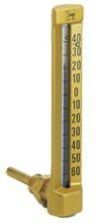
Liquid-in-glass thermometers for machines are economical and rugged. The use of high-quality glass enables the thermometer to maintain a steady measuring accuracy and repeatability. The liquid-in-glass thermometers for machines comprise a rugged protective casing, an indicating capillary and the mounting fitting with rigid connection. The protective casing is made of brass-coloured anodized aluminium or of reasonably-priced gold-coloured plastic for 150 mm lengths. Scale numbering is black.
Liquid-in-glass thermometers for machines are economical and rugged. The use of high-quality glass enables the thermometer to maintain a steady measuring accuracy and repeatability. The liquid-in-glass thermometers for machines comprise a rugged protective casing, an indicating capillary and the mounting fitting with rigid connection. The protective casing is made of brass-coloured anodized aluminium or of reasonably-priced gold-coloured plastic for 150 mm lengths. Scale numbering is black.
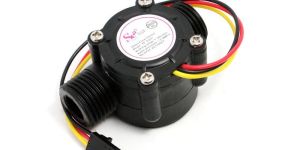
Flow meters are used in many industrial branches, particularly in the area of automated production. Various flow sensors allow exact and precise control of the flow rates and they can act quickly and automatically. In this way, a distinction is made between purely reactive systems which trigger an action when a certain flow rate is reached, and those systems which, as flow sensors, exclusively monitor and count the flow rate.Both types of systems offer a large number of variations and options. Flow sensors can be equipped with a corresponding display in order to allow a reading of the flow rate directly. By means of a measuring transmitter, some of the flow meters can also be connected to central data systems via a BUS interface, which can access the data of the flowmeters. This ensures continuous monitoring of flow rates without any problems.
Flow meters are used in many industrial branches, particularly in the area of automated production. Various flow sensors allow exact and precise control of the flow rates and they can act quickly and automatically. In this way, a distinction is made between purely reactive systems which trigger an action when a certain flow rate is reached, and those systems which, as flow sensors, exclusively monitor and count the flow rate.Both types of systems offer a large number of variations and options. Flow sensors can be equipped with a corresponding display in order to allow a reading of the flow rate directly. By means of a measuring transmitter, some of the flow meters can also be connected to central data systems via a BUS interface, which can access the data of the flowmeters. This ensures continuous monitoring of flow rates without any problems.
These differential pressure switches are IP 65, and suitable for a variety of applications such as: food industry,cannery, pharmaceutical, petrochemical, conventional and nuclear power station where it is required to control differential pressure, level, flow. The sensing element is a metallic diaphragm with two metallic bellows and acts directly on the microswitch through a self-centering pivot. The simplicity of the design, without levers, cams or similar mechanism, gives the unit an exceptionally long working life.
These differential pressure switches are IP 65, and suitable for a variety of applications such as: food industry,cannery, pharmaceutical, petrochemical, conventional and nuclear power station where it is required to control differential pressure, level, flow. The sensing element is a metallic diaphragm with two metallic bellows and acts directly on the microswitch through a self-centering pivot. The simplicity of the design, without levers, cams or similar mechanism, gives the unit an exceptionally long working life.
The capillary thermostats are fitted with liquid-filled probes made of copper that act as temperature-dependant pressure probes. A change in temperature causes a pressure change in the probe, which is transferred to a switch by a bellows system. Probe and bellows system are connected with a copper capillary.
The capillary thermostats are fitted with liquid-filled probes made of copper that act as temperature-dependant pressure probes. A change in temperature causes a pressure change in the probe, which is transferred to a switch by a bellows system. Probe and bellows system are connected with a copper capillary.
The KOBOLD flow monitor types PSE and PSR are simple, reasonably-priced and reliable monitors of fluid motions. Depending on the flow velocityflow throughput, the baffle plate is deflected and it moves over the balance arm the permanent magnet into the operating range of the reed contact mounted outside the process fluid.
The KOBOLD flow monitor types PSE and PSR are simple, reasonably-priced and reliable monitors of fluid motions. Depending on the flow velocityflow throughput, the baffle plate is deflected and it moves over the balance arm the permanent magnet into the operating range of the reed contact mounted outside the process fluid.







 Reviews & Ratings
 Write a Review


 Post Free Ad